Author and historian connecting America’s past to the forces shaping our Republic today. Evidence-driven essays on history, civics, democracy, and public life for readers who believe understanding the past is essential to protecting the future.
When the President Wants the Press Punished
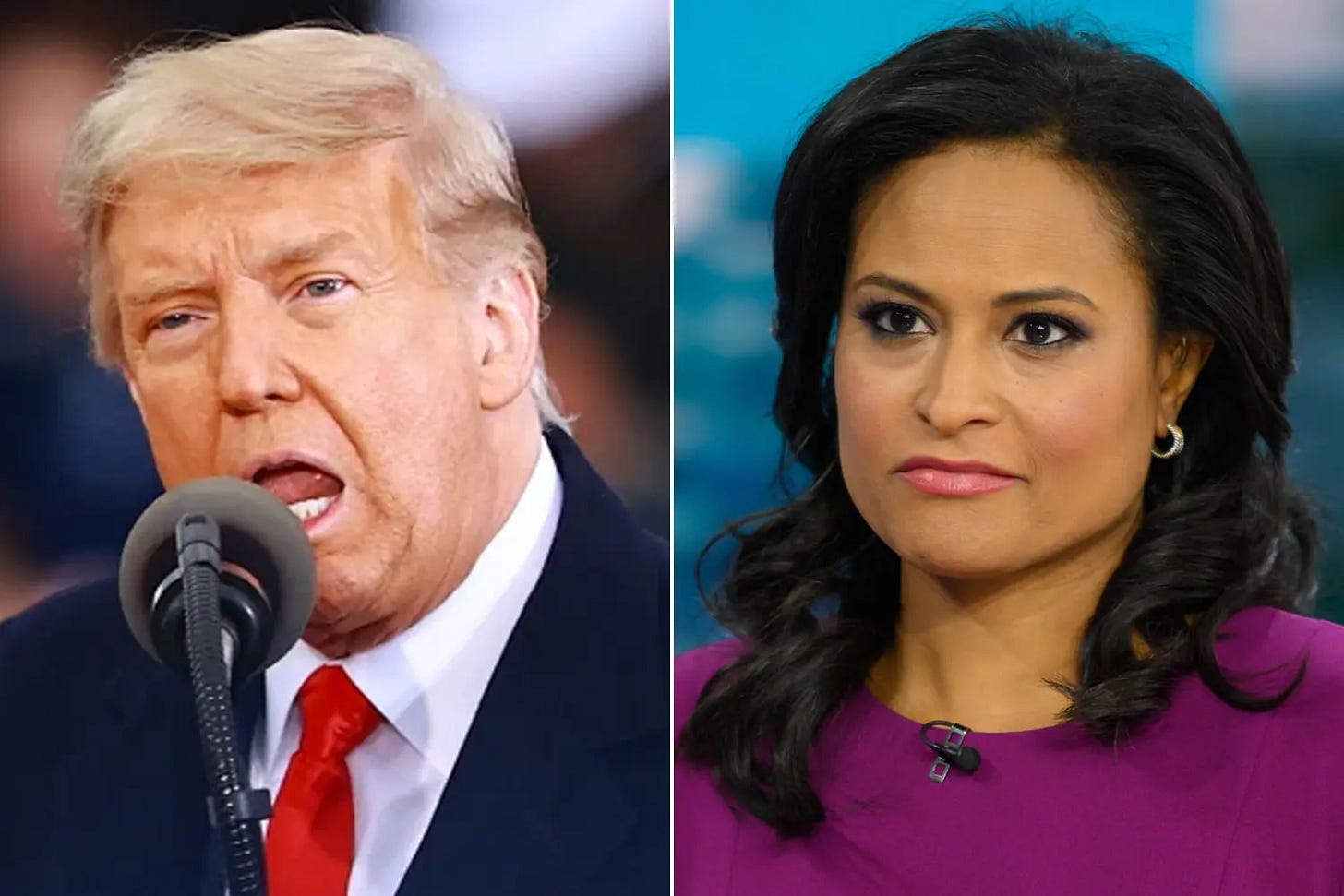
“Some degree of abuse is inseparable from the proper use of every thing; and in no instance is this more true, than in that of the press.” Dear Friends, I caught myself doing what millions of us still do on most weekend mornings, drinking coffee with the television on and half-listening to the usual discussion of polls, campaigns, and the November midterms. Nothing seemed particularly remarkable until Kristen Welker described Donald J. Trump’s endorsement record as yielding “some mixed results.” It was an ordinary piece of political analysis. She didn’t accuse the President of any wrongdoing or reveal a major government scandal. Donald J. Trump could have challenged her numbers and moved on. Instead, he announced that Welker would be reported to the Federal Communications Commission for “rebuke or punishment,” and then publicly called on the FCC to come to his rescue. You may recall that Substack’s own Jim Acosta lost his White House credentials, and the Associated Press lost privileged access for refusing to use Donald J. Trump’s preferred name for the Gulf of Mexico. Then you look at the pattern of abusive behavior over the last few years; we’ve seen women journalists face degrading attacks, and comedians and satirists such as Stephen Colbert and Jimmy Kimmel have also been targeted. After hearing this for so many years, it’s easy to dismiss the latest Trump grievance.… The difference now is that Donald J. Trump’s regime 2.0 has the machinery of the entire federal apparatus, along with tech billionaires at its disposal, to act on those grievances. It’s worth noting that the FCC is an integral part of that machinery. Congress created the commission in 1934 to regulate the nation’s rapidly expanding communications system, not to decide whether a journalist’s political analysis pleased the occupant of the Oval Office. Yet Brendan Carr, who authored the FCC chapter of Project 2025, now controls an agency whose decisions affect broadcast licenses, corporate mergers, and assets worth billions of dollars. That places extraordinary governmental power uncomfortably close to a President who has just publicly demanded that a journalist be punished for something she said on Sunday morning. History teaches us that governmental pressure doesn’t always look like censorship. It may simply look like a federal regulator reopening a routine license renewal years early. On other occasions, it could be as simple as a network weighing whether a confrontation is worth the trouble, or an executive calculating the potential impact on the next merger if the President spends another morning attacking the company. While the Oval Office occupant continues to distract and rant on Truth Social or issue extrajudicial Executive Orders, Donald J. Trump & Co. understand another form of pressure just as well: litigation. For decades, lawsuits and threats of lawsuits have been part of the Trump business playbook. ABC agreed to direct $15 million to Donald J. Trump’s future presidential library to settle litigation involving George Stephanopoulos. Paramount later paid $16 million to settle his lawsuit stemming from a 60 Minutes interview with Kamala Harris, even as its multibillion-dollar merger with Skydance was still pending federal approval. At this juncture in our story, I’d like you to imagine yourself as the CEO of a global media company, seated in the corporate boardroom. The President is suing your news division; your lawyers on retainer are billing millions; another part of the company needs a decision from his government; and federal regulators can influence transactions worth billions. The focus quickly shifts from whether your journalists have the facts right to how costly it may be to continue supporting their reporting. The Skydance merger placed CBS under the control of the Ellison family. Paramount then acquired Bari Weiss’s Free Press and named Weiss editor-in-chief of CBS News. Many of you will recall earlier this year, after 37 years at CBS, 60 Minutes correspondent Scott Pelley was fired following a bitter confrontation with the new leadership. Pelley later said Weiss had tried to alter his report on the killing of Renee Good in Minneapolis, pressuring the program to describe Good as driving toward the federal officer, a characterization Pelley said the video didn’t support and that echoed the regime’s account… Of course, CBS denied any political motive. And now Paramount is pursuing Warner Bros. Discovery, which includes CNN. If that deal ultimately succeeds, even more of the information reaching American homes will be under one corporate roof. Nobody has to imagine a secret meeting where billionaires decide tomorrow’s headlines. Concentrated power is usually more subtle than that. Owners know exactly what their companies need from Washington, and executives know which regulators matter. By the time it reaches the editors, they know which stories create trouble, but it’s always the reporters who eventually learn where the invisible fences are. Our history offers several examples of what happens when presidents face pressure points. For example, John Adams, who once defended British soldiers after the Boston Massacre, signed the Sedition Act in his later years and prosecuted opposition newspaper editors. Almost two centuries later, Nixon raged about The Washington Post and discussed its broadcast licenses. Nevertheless, Bob Woodward and Carl Bernstein kept digging, and their investigation eventually led to the Watergate scandal and cover-up and Nixon’s resignation. The lessons of Watergate have informed Donald J. Trump’s calculus, and he understands vulnerability. Therefore, Project 2025 provides his regime with a 900-page governing playbook that treats independent institutions less as safeguards and more as obstacles to executive power. Henceforth, this November is far more significant than the question of which party controls both chambers of Congress, even though regaining the gavel matters enormously if we’re ever going to reestablish accountability in our government. The deeper question is what Donald J. Trump learns between now and then. Each journalist he threatens without consequence, each corporation that settles, each regulator willing to indulge his grievance, and each complicit member of Congress who watches in silence teaches Donald J. Trump the same dangerous lesson: Nobody stopped me and told me no, so I’ll keep going. Without independent journalism, most abuses of power never become scandals because the public either remains unaware of them or learns just enough to be outraged. Watergate offers the most poignant example, as it required reporters to keep knocking on doors. The Pentagon Papers required people willing to risk their careers and face prosecution. If it weren’t for a zealous press, our nation would’ve remained ignorant and aloof about civil-rights abuses. It’s impossible to ignore them; journalists carried photographs of attack dogs and water cannons, along with testimony from places that powerful White men would’ve preferred Americans never see. That’s precisely why authoritarian movements eventually turn on the people holding notebooks, cameras, microphones, and inconvenient documents. Journalists are troublesome because they wander into places they weren’t invited to, pull records that powerful people hoped no one would read, talk to frightened witnesses, and keep asking the question even after the official answer no longer makes sense… I always argue that without a free press digging through the Epstein files, the American public might never have known that more than 5,300 files contained over 38,000 Trump-related references. When one reflects on the Welker incident, it’s easy to get caught up in the latest display of Donald J. Trump’s petulance. But if you look past the tantrum, the danger becomes far more serious when fellow Americans are being conditioned to hear a President demand that his “enemies” be arrested, prosecuted, or imprisoned and to accept it as ordinary political speech. As you may recall, Don Lemon has already been arrested by federal agents while covering a protest and held overnight in federal custody before being released. So when a President’s threats are backed by the actual power to investigate, arrest, detain, and prosecute, the distance between political vengeance and government coercion becomes frighteningly small. At the same time, the machinery of confinement is expanding at an extraordinary pace. Congress has allocated ICE $45 billion for detention capacity through 2029. In just fourteen months, the detained population rose from about 39,000 to more than 67,000, while the number of authorized detention facilities jumped from 134 to 239. Those beds are being built for immigration enforcement, but institutions have memories, and infrastructure has uses beyond the moment that created it. Our Republic should think very carefully before growing comfortable with mass detention as a routine instrument of executive power. Then listen to the men surrounding the Oval Office. Special Advisor Stephen Miller has described Trump’s commander-in-chief authority as “plenary” and argued that certain presidential determinations shouldn’t be subject to judicial review. In the meantime, Border Czar Tom Homan has said, flatly, “The president’s authority is never over.” That statement reveals either ignorance or a blatant disregard for our constitutional Republic; presidential authority is always limited. No one needs to predict martial law before the Midterms to recognize the danger ahead for our country. A terrorist attack, widespread unrest, or perceived violence in a Democrat-run city could trigger a crisis in which a regime already hostile to constitutional restraint might test emergency powers, expand National Guard deployments in blue states, and push the outer limits of “law and order.” The frightening part isn’t that we know Donald J. Trump will cross that line… It’s that the people around him are already arguing that the line is his. That brings me back to my morning coffee. Kristen Welker said Donald J. Trump had experienced “mixed results.” Four harmless syllables of political analysis were enough for the President of the United States to demand federal punishment. The First Amendment was never written because our Founders believed journalists would always be wise, fair, or pleasant. One of my favorite Founders, Benjamin Franklin, knew better from experience. Long before Independence, he stood behind his own printing press in Philadelphia, angering powerful people simply by printing what they didn’t want others to read. In 1731, after yet another round of criticism, Franklin made it clear he would not silence his press merely to appease those who disliked what appeared on its pages. Their clash with tyranny mattered, so the Founders vigorously protected a free press because they understood a painful truth about autocracy: the people running the government must never be allowed to decide what the governed are permitted to know about them. The Trump regime has gone far beyond merely collecting government data. Beginning in January 2025, DOGE sought access to IRS and Social Security records and, in partnership with Palantir, built systems to link vast stores of federal information. At the same time, the Justice Department demanded full voter-registration lists from states nationwide, even though its own Office of Legal Counsel said those records could be shared with Homeland Security for cross-checking. DHS also expanded its SAVE system to examine voter eligibility. Then, in January, FBI agents entered Fulton County, Georgia, and removed ballots, voter rolls, tabulator tapes, and other 2020 election records, at Donald J. Trump’s request, with then-Director of National Intelligence Tulsi Gabbard present. Now place that alongside the pressure being exerted on news organizations, broadcasters, reporters, and the companies that control what Americans see and hear. The same government that is gathering more information about its citizens is also gaining greater leverage over the information those citizens receive about their government. That’s the danger as November approaches. Ordinary Americans may still walk into a voting booth with a perfectly legal ballot in hand. But after almost two years of non-stop Press Secretary propaganda, manufactured grievance, intimidation, and carefully managed distraction, from DOJ stonewalling over the Epstein files to an open-ended war overseas, they’ll be asked to judge a government whose corruption, grift, and dismantling of key federal agencies have been concealed by secrecy and deliberate obstruction. We must always remember that our ballot box may survive, but its power and authority depend on something far more fragile: an informed citizen who can still see clearly enough to hold power accountable. Once our government can shape both what it knows about its citizens and what We the People are permitted to know about our government, the very concept of self-government begins to disappear. What replaces it, unfortunately, is executive aggrandizement. This is the steady concentration of power in a presidency increasingly freed from the restraints of Congress, a complicit Supreme Court, an independent civil service replaced by political loyalists, and, eventually, a subdued press. At that point, the machinery of our Republic hasn’t simply been weakened… It has been repurposed into something far removed from the constitutional government Hamilton and the Federalists envisioned and much closer to the unaccountable tyranny of the Crown our Founders fought a Revolution to escape. Vivat Constitution! P.S. If this piece gave you something worth carrying beyond the page, kindly consider sharing it and subscribing to the Open Society, either for free or as a paid member; cancel anytime. Paid members help sustain the independent research behind this work and keep these stories of history, civics, and our Republic free and available to everyone. |
L.C. Francis Open Society for History & Civics
Author and historian connecting America’s past to the forces shaping our Republic today. Evidence-driven essays on history, civics, democracy, and public life for readers who believe understanding the past is essential to protecting the future.
“Having now finished the work assigned me, I retire from the great theatre of Action.”— George Washington, December 23, 1783 Dear Friends, Let me take you on a brief journey to Annapolis, Maryland, into an afternoon that might reveal more about the spirit of our Republic than almost any battlefield from the Revolution. It was December 23, 1783. The war had ended, and the British had officially recognized American independence. That day, George Washington arrived at the Maryland State House...
“I then thought, and still think, that it was an effort of genius.”— George Washington, 1785 Dear Friends, Exactly 250 years ago this week, a man named Sergeant Ezra Lee climbed into a wooden oak vessel barely larger than a walnut shell, secured the brass hatch above him, and slipped beneath the dark tidal waters of New York Harbor. Above him, the Royal Navy loomed. Ezra Lee’s expedition followed Washington’s army, which had suffered a devastating defeat on Long Island; Manhattan was in...
“Security against foreign danger is one of the primitive objects of civil society.”— James Madison, Federalist No. 41 Dear Friends, By the time most of us enjoy our first cup of coffee this Sunday morning, roughly 1.7 million voters in the eastern German state of Saxony-Anhalt will already be casting their ballots in an election that could tell us a great deal about Europe’s future. As many of us learned in our history classes, Germany’s post-Nazi reintroduction to the international community...