Author and historian connecting America’s past to the forces shaping our Republic today. Evidence-driven essays on history, civics, democracy, and public life for readers who believe understanding the past is essential to protecting the future.
The Man Beneath the Harbor
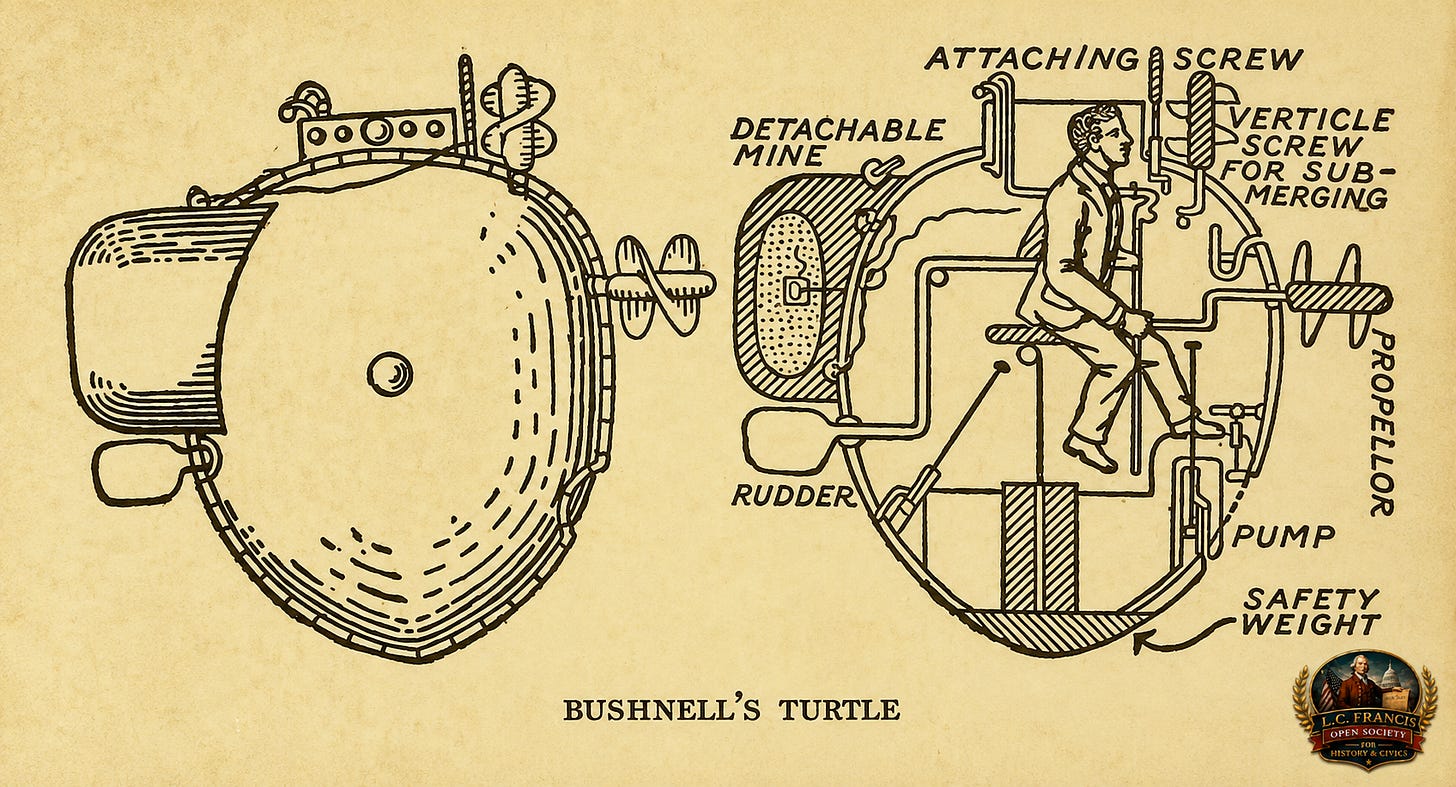
“I then thought, and still think, that it was an effort of genius.” Dear Friends, Exactly 250 years ago this week, a man named Sergeant Ezra Lee climbed into a wooden oak vessel barely larger than a walnut shell, secured the brass hatch above him, and slipped beneath the dark tidal waters of New York Harbor. Above him, the Royal Navy loomed. Ezra Lee’s expedition followed Washington’s army, which had suffered a devastating defeat on Long Island; Manhattan was in danger, and the American Revolution was barely two months removed from the Declaration of Independence. Nothing about the new nation’s survival was certain. In basic terms, Lee had volunteered for a mission that bordered on suicidal, one that required him to guide David Bushnell’s experimental submarine, the Turtle, beneath the 64-gun British flagship HMS Eagle, attach an explosive charge to its hull, and escape before the charge detonated. The machine was a claustrophobic assembly of levers, foot pumps, hand cranks, rudders, and screws. Lee had only recently learned to operate it after Bushnell’s original pilot fell ill. In the darkness, he had to control his depth, fight the harbor current, steer the vessel, and somehow position himself beneath a British warship while working almost entirely by hand. After struggling against the tide for hours, Lee reached the Eagle and repeatedly tried to drive the fastening screw into its hull. He couldn’t make it hold. Whether he struck metal sheathing or simply failed to penetrate the ship’s timbers remains uncertain, but dawn was approaching, and Lee was running out of time. He finally abandoned the attempt, released the explosive charge, and escaped. It later detonated harmlessly in the harbor. In the end, Ezra returned exhausted, having failed the mission while risking nearly everything. George Washington never forgot what Lee and Bushnell had attempted. Years later, in a letter to Thomas Jefferson, Washington admitted that he had doubted the contraption from the beginning. Too many things had to work perfectly, and too much depended on one man operating under extraordinary pressure. Yet Washington still called it an “effort of genius.” There was wisdom in that judgment. The Revolutionary generation was willing to experiment when old arrangements failed, but it was also beginning to understand the danger of placing too much trust, responsibility, or authority in any one pair of hands. That lesson eventually became part of the architecture of our Constitution. The Framers didn’t design our government because they assumed leaders would always act wisely or voluntarily restrain themselves. They designed it because they knew they would not. Authority was divided, branches were forced to compete, elections were made recurring, and power was deliberately slowed by law and procedure… Our constitutional system was never intended to be perfectly efficient. In many ways, the friction was the protection. We can see that principle put into practice every day. The executive branch has asked the Supreme Court for emergency permission to enforce new Postal Service rules governing mail ballots ahead of the midterms. The Trump regime argues that requirements for voter lists, barcodes, and ballot handling are necessary to protect election integrity. Of course, opponents contend, rightly, that changing procedures after voting has begun could cause lawful ballots to be rejected; a federal judge has blocked the rules for now. At the same time, another legal fight has limited the use of federal immigration databases to verify citizenship on state voter rolls, while the White House continues its confrontation with the Smithsonian over how our national history is presented. Mail ballots, federal databases, and museum exhibits may seem to have little in common, yet each raises a question that has followed us since the founding. How much authority should any president be permitted to exercise when other institutions say no? Americans can disagree about mail voting, citizenship verification, federal authority, and how our history should be presented. We should argue about those issues, demand evidence, challenge decisions, litigate disputes, and force government to explain itself… That friction is not a weakness in our Republic. It is part of how our Republic protects itself. What matters is what happens when a president hears no. Congress, the courts, the states, and election officials possess authority of their own, and our constitutional system depends on those boundaries being respected. The current disputes are therefore about more than administrative policy. They test whether the executive branch will accept lawful limits it dislikes. The Founders understood the danger clearly and framed our Constitution so that no president should ever become the final judge of the boundaries of his own power. Ezra Lee didn’t climb into a suffocating wooden vessel in New York Harbor so Americans could replace one king with a more efficient one. The Revolutionary generation was fighting for something far more difficult. They sought a political order in which power answered to citizens… not one in which citizens bowed to power. The Founders understood that winning independence was only the beginning, and that preserving it would require a Constitution strong enough to govern and institutions strong enough to restrain those who governed. I often think of Benjamin Franklin’s famous exchange at the close of the Constitutional Convention in 1787. When Elizabeth Willing Powel asked what kind of government the delegates had created, Franklin gave the answer that still echoes through our Republic today: “A republic, if you can keep it.” The true test of constitutional principle has never been whether we defend restraints when they bind the other side. But rather, it comes when those same restraints slow a policy we favor, frustrate a leader we support, or protect people with whom we strongly disagree. That is when principle is either real or merely convenient. I’ve always maintained that our Constitution, which restrains only our opponents, is no Constitution at all. It’s simply another instrument of power in the hands of whoever happens to hold it. That is why Ezra Lee still belongs in our conversation 250 years later. He surfaced from New York Harbor without sinking the Eagle, and by the narrow measure of military success, his mission failed. Yet the political experiment better known today as self-government, which he helped defend, endured because later generations understood that liberty depends on more than courage in moments of crisis… It depends on institutions, habits of restraint, and a citizenry unwilling to surrender constitutional limits merely because power finds them inconvenient. We inherited a system in which political conflict was meant to be resolved through ballots, courts, legislatures, and law rather than by force, and that inheritance carries its own obligations. Citizenship in our Republic is therefore more demanding than obedience and more serious than partisanship. It requires us to defend constitutional boundaries even when doing so frustrates our own side, slows the outcome we want, or protects those with whom we profoundly disagree. The durability of our Republic has always depended on that discipline. We the People remain sovereign only so long as those who wield power remain bound by our Constitution, which gives them their authority. The moment we permit any leader to rise above those limits, we’re no longer rightful citizens but Subjects; our Constitution is eventually displaced by autocratic rule, and tyranny is no longer a warning from history… It’s what we have permitted to take the place of our Republic. Vivat Constitution! P.S. If this piece gave you something worth carrying beyond the page, kindly consider sharing it and subscribing to the Open Society, either for free or as a paid member; cancel anytime. Paid members help sustain the independent research behind this work and keep these stories of history, civics, and our Republic free and available to everyone. |
L.C. Francis Open Society for History & Civics
Author and historian connecting America’s past to the forces shaping our Republic today. Evidence-driven essays on history, civics, democracy, and public life for readers who believe understanding the past is essential to protecting the future.
“Having now finished the work assigned me, I retire from the great theatre of Action.”— George Washington, December 23, 1783 Dear Friends, Let me take you on a brief journey to Annapolis, Maryland, into an afternoon that might reveal more about the spirit of our Republic than almost any battlefield from the Revolution. It was December 23, 1783. The war had ended, and the British had officially recognized American independence. That day, George Washington arrived at the Maryland State House...
“Security against foreign danger is one of the primitive objects of civil society.”— James Madison, Federalist No. 41 Dear Friends, By the time most of us enjoy our first cup of coffee this Sunday morning, roughly 1.7 million voters in the eastern German state of Saxony-Anhalt will already be casting their ballots in an election that could tell us a great deal about Europe’s future. As many of us learned in our history classes, Germany’s post-Nazi reintroduction to the international community...
“Power must never be trusted without a check.”—John Adams to Thomas Jefferson, 1816 Dear Friends, If you’ve ever crossed Arlington Memorial Bridge from Washington, you know the view, even if you’ve never thought much about why it feels different from the rest of the city. Behind you sits Abraham Lincoln. Ahead lies Arlington National Cemetery, with Arlington House above it. The open line between them was deliberately created, connecting the president who preserved our Union with ground that...