Author and historian connecting America’s past to the forces shaping our Republic today. Evidence-driven essays on history, civics, democracy, and public life for readers who believe understanding the past is essential to protecting the future.
When Fascism Stops Looking Like Fascism
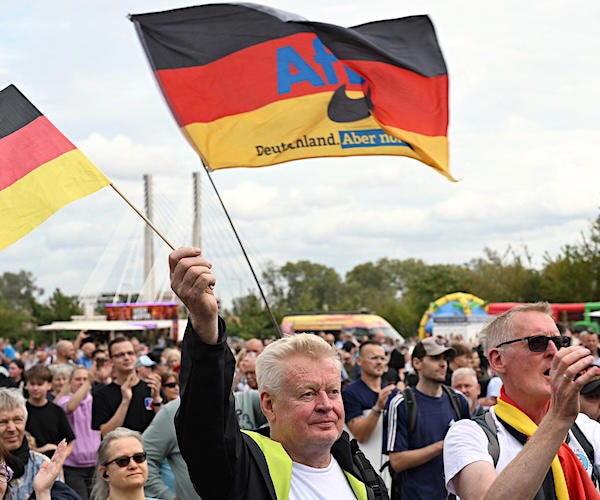
“Security against foreign danger is one of the primitive objects of civil society.” Dear Friends, By the time most of us enjoy our first cup of coffee this Sunday morning, roughly 1.7 million voters in the eastern German state of Saxony-Anhalt will already be casting their ballots in an election that could tell us a great deal about Europe’s future. As many of us learned in our history classes, Germany’s post-Nazi reintroduction to the international community was carefully tied to NATO, the European Union, and the democratic institutions built from the wreckage of the Second World War. For decades, that framework helped make German power safe for Europe. Now, it is being tested from two directions at once. Since his first term and continuing into his current term, Donald J. Trump has repeatedly urged Europe to shoulder more of its defense burden. Meanwhile, uncertainty about Washington’s long-term commitment has prompted France and Germany to prepare for a future in which they may have to do far more on their own. Germany, under Chancellor Friedrich Merz, is rearming at a pace not seen in generations. At the same time, a growing share of German voters is turning to a far-right party that seeks closer relations with Russia, less dependence on the United States and a weaker European Union. That’s what makes today’s election in Germany impossible to dismiss as an obscure local contest. Among Saxony-Anhalt’s 1.7 million residents, the latest data show the Alternative für Deutschland (AfD) polling at 42 percent, nearly double the Christian Democrats’ support. If that number holds anywhere near form, Germany won’t simply be watching another protest vote. It will be confronting a far harder question: What happens when a country rebuilds its military power while the political consensus that once restrained that power begins to fracture? One state election won’t change German foreign policy on Monday morning, and the AfD may still fall short of an outright majority. But dismissing this as another European protest vote would miss the larger story. Germany is doing two things at once: rebuilding military power at a pace unseen in generations while one of its fastest-growing political movements questions the alliances and institutions that made the return of German military power acceptable in the first place. Germany’s regular defense budget has risen to €82.7 billion this year, with an additional €25.5 billion available through the Bundeswehr’s special fund. Berlin also plans to raise core defense spending to 3.5% of GDP by 2029, as part of NATO’s broader commitment to devote 5% of GDP to defense and security by 2035. More strikingly, Germany is establishing a permanent armored brigade of roughly 5,000 military and civilian personnel in Lithuania, marking the first permanent German military deployment abroad since the Second World War. And just this week, the Bundeswehr successfully tested an Israeli-made ballistic missile capable of reaching targets up to 500 kilometers away. There are sound reasons for the sense of urgency and the rationale for this expenditure. Since Russia’s invasion of Ukraine in 2022, NATO’s eastern members have warned for years that Moscow poses a direct threat, and Germany has accused Russia of involvement in an explosive-laden drone attack at Leipzig/Halle Airport. Merz has also concluded that American presidents of both parties have long pressed Europe: a wealthy country of more than 80 million people cannot indefinitely expect the United States to bear so much of the burden of defending the continent. I don’t object to Germany becoming capable of defending itself. Given the world we live in now, I’m not sure it has much choice. What should concern us, however, is who may eventually inherit the military Germany is building and what they may decide to do with it. That question takes us back to 1945. The challenge facing the Western democracies after Hitler’s defeat was not simply how to punish Germany or keep it permanently weak. We must never lose sight of the fact that Germany sat at the industrial and geographic center of Europe, while Soviet power spread across Eastern Europe. The harder question was how to allow Germany to become prosperous, sovereign, and militarily capable again without recreating the conditions that had twice plunged Europe into catastrophe. The answer was to bind German power within institutions. In 1950, French Foreign Minister Robert Schuman proposed placing French and German coal and steel production under common authority, making another war between them “not merely unthinkable, but materially impossible.” From that beginning grew the European institutions that eventually became the European Union as we know it today. When West Germany entered NATO in 1955 and created the Bundeswehr, its military was embedded in the Atlantic alliance and within a constitutional democracy that conceived of soldiers as citizens in uniform, answerable to civilian authority and the Basic Law. That became the postwar bargain under which Germany could become strong again, but only if its strength remained tied to democracy, Europe, and the Atlantic alliance. For most of the next seventy years, it worked reasonably well. Now read the AfD’s own platform… The party wants Germany to be militarily stronger. It supports rebuilding the Bundeswehr, restoring conscription, and expanding an autonomous German defense industry. But it also rejects further eastward enlargement of NATO, opposes the deployment of long-range American weapons on German soil, wants sanctions against Russia lifted, and Nord Stream repaired, and says Ukraine should remain outside both NATO and the European Union. Most revealingly, the AfD says Germany’s NATO membership should remain central only until Europe establishes an independent and capable military alliance of its own. That’s the contradiction we should be discussing. Merz is strengthening Germany because he believes Russia threatens NATO and the European democratic order. The AfD wants much of that strength too, but imagines a Germany more independent of Washington, more accommodating toward Moscow, and less bound to the political integration that has governed European security since the war. The danger isn’t a stronger Germany by itself… It’s a stronger Germany gradually detached from the institutions that made German strength safe. The AfD’s rise hasn’t occurred in isolation. After leaving Donald J. Trump’s first White House, Steve Bannon began building a transatlantic right-wing nationalist network. His formal project never became the disciplined machine he envisioned, but Bannon spent years cultivating figures in the AfD, Marine Le Pen’s movement in France, Matteo Salvini’s League in Italy, and Viktor Orbán’s Hungary, while his War Room continued to promote many of the same parties and themes. Bannon didn’t have to stoke European nationalism, and there’s no evidence he directly or indirectly influenced the AfD’s campaign strategy. What is concerning is that he recognized that movements with different flags could share the same political language, including hostility toward supranational institutions, suspicion of immigration, contempt for established media, and a belief that national sovereignty had been surrendered to distant elites. Moscow also recognized something similar. I’ve not been able to connect the former KGB (now the FSB) to the AfD leadership and its campaign machinery. In fact, Putin doesn’t need to, since millions of eastern Germans already hold real grievances over immigration, energy costs, economic stagnation, and the unfinished legacy of reunification. Unfortunately, Russian actors have exploited those divisions through cyberattacks, disinformation, and covert influence campaigns. As a matter of fact, German authorities have traced election-related operations to Russian networks, and the European Union sanctioned Voice of Europe after concluding it had been used to spread Kremlin narratives and cultivate political influence across the continent. That doesn’t prove Moscow controls Germany’s far right, but it does show something much more significant beneath the surface: Russia doesn’t have to manufacture German dissatisfaction if it can learn to amplify it… That matters because Putin doesn’t have to defeat NATO on the battlefield if Europeans eventually weaken the alliance for him at the ballot box. As we look across the European continent, France may be the next great test. For example, Marine Le Pen’s National Rally remains one of the strongest forces in French politics, and Le Pen has again argued that France should withdraw from NATO’s integrated military command while remaining formally in the alliance. It’s important to remember that France is a bona fide nuclear power, a permanent member of the United Nations Security Council, and, together with Germany, one of the two central pillars of modern Europe. If Paris begins to pull away from NATO while Berlin moves toward greater strategic independence, the problem is no longer theoretical… The political center of Europe itself begins to shift. Now, consider France and Germany on the same strategic map. Picture France gradually stepping back from NATO command, while a potential German government, emboldened by a modernized, upgraded military, becomes more interested in strategic independence, shows less commitment to Ukraine, and is more open to restoring ties with Moscow. Meanwhile, imagine an American electorate that’s growing more impatient with European defense efforts, alongside a nationalist movement in the U.S. that has spent years building ideological ties across the Atlantic. Nobody has to hold a ceremony to announce NATO’s end. Article 5 on mutual defense can remain exactly where it has been since 1949, but collective defense works only if Moscow believes Paris, Berlin, Warsaw, London, and Washington will act together… However, if the Kremlin concludes that France may hesitate, Germany may prefer neutrality, and America may stay home, the military balance shifts before a Russian tank moves another mile. That’s precisely what the architects of the postwar world understood. Schuman didn’t merely ask France and Germany to promise they would remain friends. Konrad Adenauer didn’t rebuild the German army and assume that every future German government would use it wisely; he built institutions because he didn’t trust the future. And this is where our news coverage often fails us. The facts are not hidden; they are fragmented. One headline tells us that Germany is rearming. Another says the AfD may take more than 40 percent in an eastern state. Another reports on Russian disinformation. Elsewhere, we read about Bannon, Le Pen, Ukraine, or another American argument over NATO… Each arrives as a separate story, but when you put the puzzle together, something larger emerges. Germany is rearming on a scale unseen since the Nazi era, even as the political consensus that once made that power feel secure begins to fray. At the same time, Russia is working to widen divisions within European democracies, while nationalist movements, in concert with Steve Bannon et al. on both sides of the Atlantic, increasingly echo the language of grievance, sovereignty, and betrayal that has destabilized democracies before… France may soon face its own test, and here at home, more Americans are questioning whether the alliance built after the Second World War is still worth the cost. That is why Saxony-Anhalt matters to us on this Sunday morning. Today, Germany is very different from Weimar, and it’s also unfair to link every rise of the far right to 1933. Its courts are independent, its military is under constitutional control, and its democratic spirit is much stronger and more mature than it was a hundred years ago. The warning is more nuanced yet demanding. My father’s generation, which built the postwar order, understood that democratic institutions had to endure voters and leaders who might one day forget why those institutions existed. They tied armies to alliances, national economies to one another, and political power to democratic restraints because they had already learned what happens when grievance, nationalism, and military strength reinforce one another. For more than eighty years, we have lived in the world they built. Now we are entering the period they knew would eventually arrive: the people who remember the catastrophe are disappearing, while the institutions born of that memory endure. Chancellor Merz can build an army for Germany, and France can maintain its nuclear deterrent, all while we in America can spend another trillion dollars on defense… None of it will protect the democratic world if the people commanding those weapons stop believing that our common defense is truly common. By the time we finish our coffee this morning, voters in Saxony-Anhalt will still be casting their ballots. Their decision will not determine Europe’s future in a single day, but it may reveal whether the political foundations of the postwar order are beginning to shift. I’ve always believed the gravest threat to our postwar order wouldn’t necessarily come from an enemy strong enough to destroy it from the outside. But rather, it may come from within, from generations who inherit its protections without remembering or fully grasping the catastrophe that made them necessary. History shows us that institutions become easiest to abandon when people can no longer remember the price their absence once demanded. Vivat Constitution! P.S. If this piece gave you something worth carrying beyond the page, kindly consider sharing it and subscribing to the Open Society, either for free or as a paid member; cancel anytime. Paid members help sustain the independent research behind this work and keep these stories of history, civics, and our Republic free and available to everyone. |
L.C. Francis Open Society for History & Civics
Author and historian connecting America’s past to the forces shaping our Republic today. Evidence-driven essays on history, civics, democracy, and public life for readers who believe understanding the past is essential to protecting the future.
“Having now finished the work assigned me, I retire from the great theatre of Action.”— George Washington, December 23, 1783 Dear Friends, Let me take you on a brief journey to Annapolis, Maryland, into an afternoon that might reveal more about the spirit of our Republic than almost any battlefield from the Revolution. It was December 23, 1783. The war had ended, and the British had officially recognized American independence. That day, George Washington arrived at the Maryland State House...
“I then thought, and still think, that it was an effort of genius.”— George Washington, 1785 Dear Friends, Exactly 250 years ago this week, a man named Sergeant Ezra Lee climbed into a wooden oak vessel barely larger than a walnut shell, secured the brass hatch above him, and slipped beneath the dark tidal waters of New York Harbor. Above him, the Royal Navy loomed. Ezra Lee’s expedition followed Washington’s army, which had suffered a devastating defeat on Long Island; Manhattan was in...
“Power must never be trusted without a check.”—John Adams to Thomas Jefferson, 1816 Dear Friends, If you’ve ever crossed Arlington Memorial Bridge from Washington, you know the view, even if you’ve never thought much about why it feels different from the rest of the city. Behind you sits Abraham Lincoln. Ahead lies Arlington National Cemetery, with Arlington House above it. The open line between them was deliberately created, connecting the president who preserved our Union with ground that...