Author and historian connecting America’s past to the forces shaping our Republic today. Evidence-driven essays on history, civics, democracy, and public life for readers who believe understanding the past is essential to protecting the future.
When the Oath Becomes a Loyalty Test
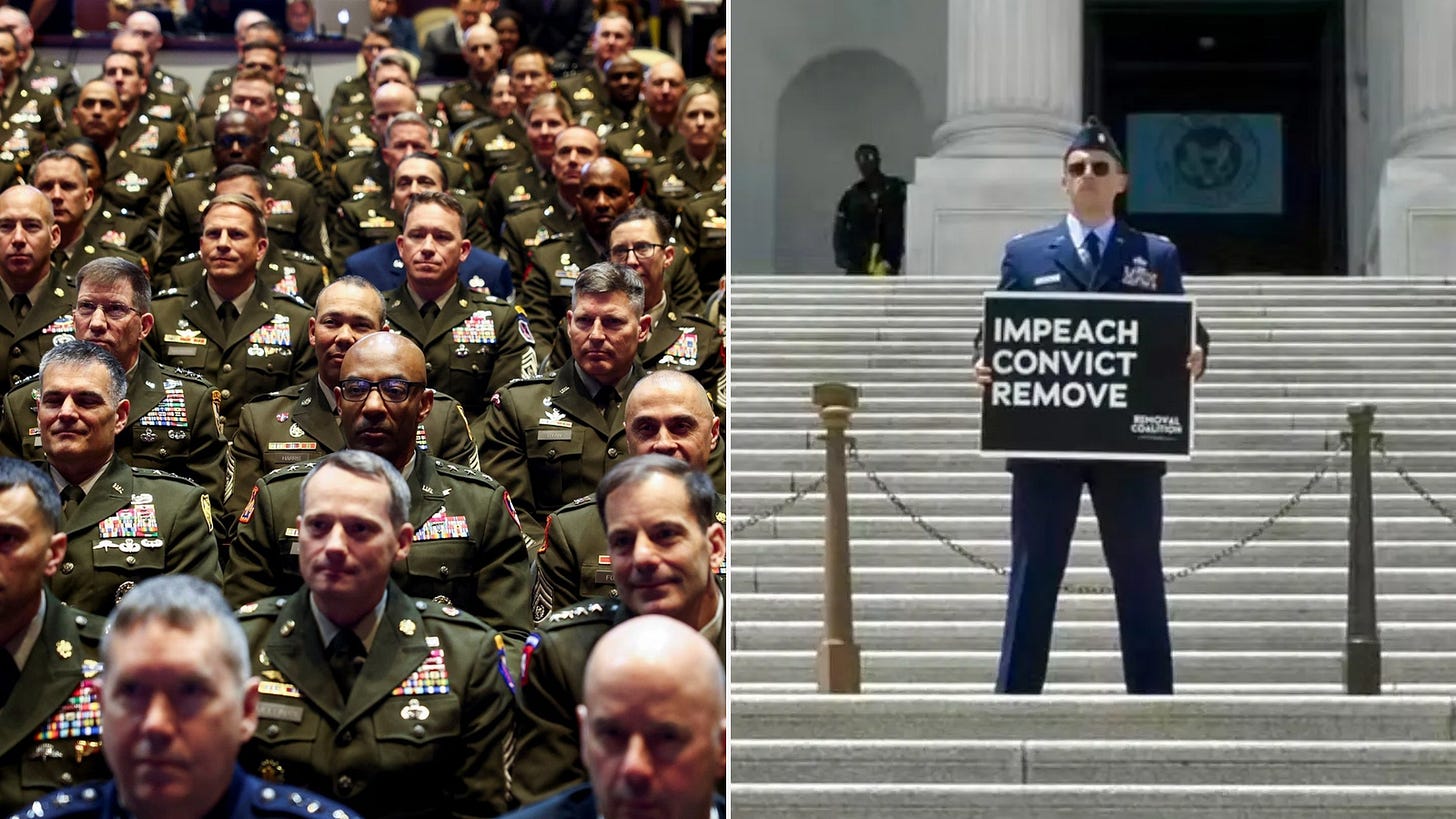
“A standing military force, with an overgrown Executive will not long be safe companions to liberty.” Dear Friends, Last September, I captured the image above for an article titled “The Silence at Quantico: A Republic Tested,” which depicted a gathering of our nation’s top-ranking military leaders at Quantico. Hundreds of America’s senior generals, admirals, and senior Enlisted leaders had been summoned from commands around the world and seated before Donald J. Trump and Pete Hegseth. The Commander-in-Chief looked across the unusually quiet auditorium and began his speech with a veiled threat: if you don’t like what I am saying, if you get up and walk out, you could lose your rank and pension. After nearly three decades in naval uniform, I knew immediately that I wasn’t just hearing ordinary presidential banter. I’m quite certain of what I heard, and what every career military member in that Quantico auditorium understood as well. Those words represented decades of deployments, family separations, and professional reputations built one assignment at a time. So, when the Commander-in-Chief reminds military leaders that their careers ultimately pass through his hands, the distance between a joke and a warning becomes very small. At the time, I wondered whether Quantico would simply fade into the daily buffoonery and incompetence of this regime. But nearly a year later, it looks less like an isolated moment and more like a warning of what was coming. Donald J. Trump spoke that day of an “enemy from within,” hinting that American cities could serve as training grounds for military forces. Hegseth supplied the institutional half of the message, wrapping his vision of military power in Christian nationalism, testosterone, and a relentless campaign against anything he perceives as weak, woke, or disloyal. Then Secretary Hegseth told the assembled leadership that “Personnel is policy,” making clear that officers unwilling to embrace that transformation should consider leaving. He even distinguished between those who had simply carried out the previous administration’s lawful policies and those he believed had absorbed too much of that culture to be entrusted with his own. That distinction should trouble anyone who understands how an apolitical military is supposed to function. A professional officer serves the lawful policies of one administration and, after an election, the lawful policies of the next. That’s a far cry from ideological contamination. That’s civilian control, because yesterday’s lawful service can be held against an officer tomorrow; obedience itself becomes a career risk. Donald J. Trump selected a former Fox News host and National Guard major to lecture a room of officers and senior enlisted leaders who had commanded fleets, wings, corps, and combat formations on a scale Hegseth had never come close to commanding. There he stood, Old Glory neatly folded into his pocket square, pacing back and forth before men and women hardened by two decades of war while preaching toughness, grievance, and a narcissistic version of masculinity, all bound together by the one quality this regime seems to prize above judgment, experience, or candor: loyalty to the man in the Oval Office. Secretary Hegseth was handed authority over roughly 3.4 million service members and civilians, forces and installations spanning the globe; eleven combatant commands, the nuclear deterrent, and resources now measured in the trillions of dollars. There’s no room at that level for confusing certainty with competence. Yet too much of what we’ve watched since Donald J. Trump’s return to the Oval Office has had the unsettling quality of handing someone the controls of a lunar module, only to discover after launch that confidence had been mistaken for mastery. One of the earliest casualties of Hegseth’s purge was Gen. C.Q. Brown Jr., a combat-tested fighter pilot who had risen through nearly four decades of demanding commands to become the Chairman of the Joint Chiefs of Staff. Then came Hegseth’s assault on women in our military, beginning with Admiral Lisa Franchetti, Chief of Naval Operations, who was also removed. Admiral Franchetti’s dismissal is personal to me because I had the opportunity to know and work for her. I watched Lisa Franchetti’s dedication to our nation; she was a disciplined professional who never fit neatly into anyone’s political talking points. She was more qualified than most of the men I served with under her command, hands down. She commanded at sea, led carrier strike groups, commanded the Sixth Fleet and NATO striking forces, served as Vice Chief of Naval Operations, and eventually became the Navy’s senior officer. She didn’t receive four stars because someone in Washington wanted a woman in the photograph… She earned them in a predominantly male institution that had tested her repeatedly before entrusting her with a Numbered Fleet. That’s why I find it difficult to accept Hegseth’s repeated mention of ‘merit.’ I have personally seen what true merit looks like in Admiral Lisa Franchetti, and it’s inspiring. My concern grew as Hegseth continued reshaping senior leadership. During Senate testimony, he acknowledged being summoned by Donald J. Trump to change the department’s culture and argued that doing so required removing some of those who had been part of it. At the same hearing, Senators challenged him about the disproportionate number of Black and female officers among senior leaders removed without publicly stated performance failures. In response, Hegseth denied that race or sex determined those decisions and insisted that merit remained the standard. At the end of the day, an Army colonel doesn’t need a formal loyalty test to start thinking about which opinions are safe to share. When a commander decides whether to challenge a false assumption, they only need to recall what happened to those who became inconvenient. So the greatest harm might come not only from the officers Donald J. Trump and Hegseth remove, but also from what everyone else who stays behind learns about survival. When we look back on our history, we see how dearly Americans have paid when political power overwhelms professional judgment. In Vietnam, Robert McNamara and his team of brilliant systems analysts believed that data, body counts, and managerial control could bend a war to their assumptions. Instead, bad news was softened on the way up, doubt became a career risk, and mission creep hardened into a catastrophe. The lesson was not that our institutions lacked intelligence, but that even brilliant institutions can be bullied from the Oval Office when the people inside them learn that contradicting powerful men carries a price. Taken together, these developments explain why Donald J. Trump and Hegseth are more dangerous as a partnership than either man would be on his own. The Oval Office occupant brings an extraordinary fixation on personal loyalty and increasingly labels domestic political opponents “enemies.” Hegseth brings the conviction that remaking the military requires remaking the people and culture within it. Together, they create an environment in which officers may begin asking not only what the Constitution and their profession require, but also what the men controlling their careers want to hear. And that brings us to Air Force Maj. Jason Watson. Watson stood near the Capitol, holding a sign calling for the impeachment, conviction, and removal of Donald J. Trump and Vice President JD Vance. He knew that active-duty commissioned officers are subject to restrictions that civilians are not. Article 88 of the Uniform Code of Military Justice restricts contemptuous speech by officers directed at senior elected officials, and there is good reason to keep the American officer corps from openly dividing along partisan lines. Watson stepped forward anyway. He was detained, charged, and held in pretrial confinement while the military justice system considers his case. What’s important is that we should recognize Major Watson’s courage. Watson put his career and his liberty behind what he believed. He didn’t wait until retirement to write a memoir explaining that he had been privately alarmed. He didn’t whisper anonymously to a reporter and let somebody else absorb the consequences. He stood where everyone could see him, knowing full well that the uniform on his back made the possible price far higher. That took intestinal fortitude, and We the People should ensure he’s not forgotten now. When a commissioned officer is detained after openly criticizing the President and Vice President, citizen oversight isn’t interference but accountability by the people in whose name the government operates. Watson’s case also brings us directly back to Quantico. An active-duty major may lose his liberty while military courts determine whether his criticism of the President crossed a legal line. Yet that same President can stand before hundreds of officers who cannot answer him as ordinary citizens, speak of an “enemy from within,” suggest American cities as military training grounds and remind them that their rank and future are vulnerable. The situations are legally different, but the officer corps is perfectly capable of understanding the larger lesson being taught. My years in uniform taught me that the officer you want beside you is the one willing to tell a superior, face-to-face, that the plan is failing, the intelligence is flawed, or the order has crossed a legal line. That kind of courage disappears the moment officers believe an honest answer can cost them everything they spent a lifetime earning. And that’s what makes what’s happening inside our military so dangerous. We’re not simply arguing over who receives another star, which books are banned at West Point or Annapolis, or whether the Air Force Major spends another night in the military brig. More importantly, however, we’re setting the terms by which military professionals survive and advance. So the broader question is whether we continue to reward officers for judgment, candor, and the courage to tell civilian leaders when they’re wrong, or whether we teach them that the safer career path belongs to the officer who understands the politics above him and knows when to keep quiet. The oath to our Constitution will still be administered, and midshipmen and cadets will still raise their right hands and repeat the same words that generations before them did. But an oath becomes little more than ceremony when fidelity to the Constitution is expected in public while fidelity to the White House determines who advances, who commands, and who survives. The day an American officer believes the Constitution owns his conscience but the President owns his career, civilian control will have been twisted into political obedience. The uniform may still read United States, but the courage inside it will have learned to answer to one man. Vivat Constitution! P.S. If this piece gave you something worth carrying beyond the page, kindly consider sharing it and subscribing to the Open Society, either for free or as a paid member; cancel anytime. Paid members help sustain the independent research behind this work and keep these stories of history, civics, and our Republic free and available to everyone. |
L.C. Francis Open Society for History & Civics
Author and historian connecting America’s past to the forces shaping our Republic today. Evidence-driven essays on history, civics, democracy, and public life for readers who believe understanding the past is essential to protecting the future.
“Having now finished the work assigned me, I retire from the great theatre of Action.”— George Washington, December 23, 1783 Dear Friends, Let me take you on a brief journey to Annapolis, Maryland, into an afternoon that might reveal more about the spirit of our Republic than almost any battlefield from the Revolution. It was December 23, 1783. The war had ended, and the British had officially recognized American independence. That day, George Washington arrived at the Maryland State House...
“I then thought, and still think, that it was an effort of genius.”— George Washington, 1785 Dear Friends, Exactly 250 years ago this week, a man named Sergeant Ezra Lee climbed into a wooden oak vessel barely larger than a walnut shell, secured the brass hatch above him, and slipped beneath the dark tidal waters of New York Harbor. Above him, the Royal Navy loomed. Ezra Lee’s expedition followed Washington’s army, which had suffered a devastating defeat on Long Island; Manhattan was in...
“Security against foreign danger is one of the primitive objects of civil society.”— James Madison, Federalist No. 41 Dear Friends, By the time most of us enjoy our first cup of coffee this Sunday morning, roughly 1.7 million voters in the eastern German state of Saxony-Anhalt will already be casting their ballots in an election that could tell us a great deal about Europe’s future. As many of us learned in our history classes, Germany’s post-Nazi reintroduction to the international community...