Author and historian connecting America’s past to the forces shaping our Republic today. Evidence-driven essays on history, civics, democracy, and public life for readers who believe understanding the past is essential to protecting the future.
He Couldn’t Wait for History
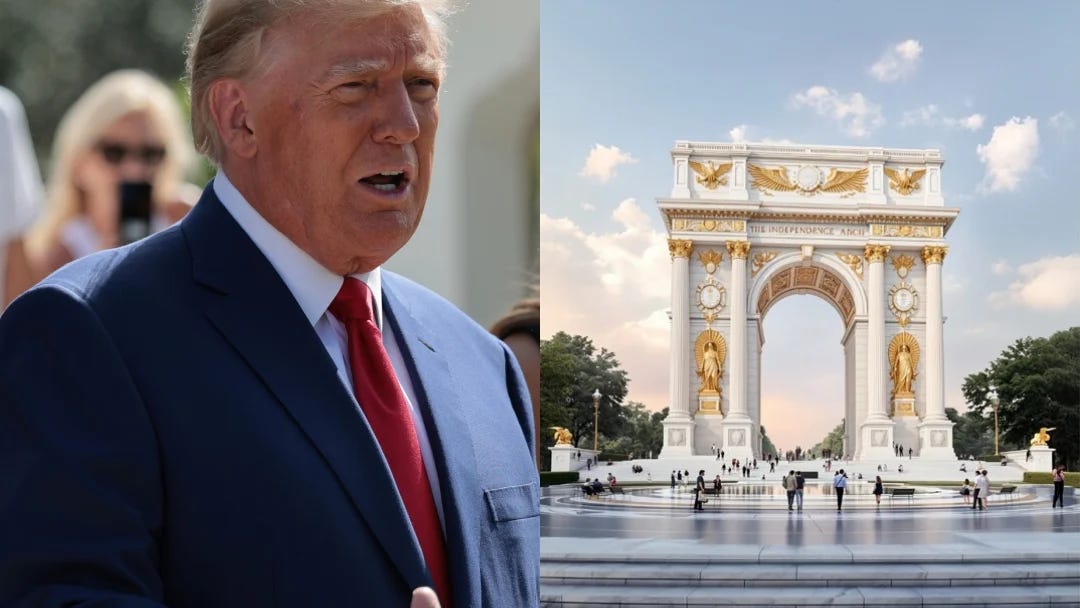
“Power must never be trusted without a check.” Dear Friends, If you’ve ever crossed Arlington Memorial Bridge from Washington, you know the view, even if you’ve never thought much about why it feels different from the rest of the city. Behind you sits Abraham Lincoln. Ahead lies Arlington National Cemetery, with Arlington House above it. The open line between them was deliberately created, connecting the president who preserved our Union with ground that became sacred because of the terrible price Americans paid when that Union nearly came apart. There’s an old sailor named Shaun Byrnes who knows that road particularly well. Byrnes is 83 now, but during the Vietnam War he served four years in our Navy, much of it in South Vietnam. During one attack, he stepped away from a gun platform moments before the weapon overheated and exploded. Three men were killed, and Byrnes survived with severe burns. He came home and then spent another thirty years serving our nation in the Foreign Service, much of that time spent confronting the Soviet Union overseas. He describes himself as politically moderate and says he never imagined that, late in life, he would find himself suing his own government. Yet that’s exactly what he’s doing. Byrnes is one of three Vietnam veterans, along with an architectural historian, trying to stop Donald J. Trump from placing a 250-foot triumphal arch in Memorial Circle, directly between the Lincoln Memorial and Arlington National Cemetery. Byrnes isn’t thinking only about himself. He still thinks about the friends who never came home from Vietnam, including men whose bodies were never recovered. He had planned to be buried at Arlington someday. Now he says that if this enormous arch is built at the entrance, he may reconsider. His objection is striking because it isn’t really about architecture. Byrnes understands something we seem to be forgetting about memorials. Washington’s great monuments were not generally commissioned by living presidents seeking to dictate how history would remember them. In fact, it’s the citizens and later generations who made those judgments after the lives had ended, when history could speak for itself. Donald J. Trump appears unwilling to leave that judgment to us. Asked previously who the arch was really for, Donald J. Trump answered simply, “Me.” This week, after Senator Jon Ossoff suggested that Mr. Trump was building monuments to himself because nobody would do it after he was gone, the President responded, “That’s true,” and added, “Nobody will do it once I’m gone.” Well, there it is. The administration describes the arch quite differently. Its planning documents state that the structure is intended to celebrate the triumphs of the American people, inspire patriotism, honor our nation’s sacrifices, and beautify our capital as we mark America’s 250th anniversary. There’s nothing inherently wrong with building a monument to our national achievement, and a triumphal arch celebrating 250 years of our Republic could be magnificent if Congress and the American people decided that was how we wished to commemorate ourselves. But that’s not what is happening. The proposed arch would rise 250 feet above Memorial Circle. The Lincoln Memorial is 99 feet tall. Paris’s Arc de Triomphe, which inspired much of this design, stands about 164 feet. Trump’s arch would therefore be more than two and a half times the height of the Lincoln Memorial and about 86 feet taller than the Parisian original. This isn’t a minor addition to the landscape of our nation’s capital. A 250-foot arch at Memorial Circle would loom over the ceremonial approach to Arlington, where nearly 430,000 service members, veterans, and their families are buried. That ground already has a meaning, and it didn’t come from architecture. Our government already has a process for decisions of that magnitude, and that’s where this story becomes far more troubling than an argument about taste. The National Capital Planning Commission granted preliminary approval in July, but final approval has not yet been granted. Questions remain about the structure’s enormous height and whether an exemption from Washington’s usual height restrictions is required. More fundamentally, the veterans argue that federal law requires Congress to authorize a commemorative structure on this federal land, and Congress has never approved this arch. The administration disputes that. Its lawyers argue that congressional authority stems from a 1925 law establishing the commission that originally built the Arlington Memorial Bridge. That commission disappeared generations ago, but the administration contends that its authorization can support the new project. That’s now for our courts to decide, but the government’s behavior while that question remains unresolved should concern us. On Thursday, Interior Secretary Doug Burgum announced that excavation at the site would begin soon. On Friday, the administration told the court that it plans to dig four test pits, beginning no earlier than September 21st, to search for archaeological material, and insisted that this work isn’t actual construction. The veterans went back to court immediately, warning that the administration was trying to move quickly enough to create a fait accompli by starting a project and later arguing that too much had already been done to stop it. U.S. District Judge Tanya Chutkan responded Friday by reinforcing the limits already imposed on the administration. With narrow exceptions for archaeological work, our government must notify the court before other activity begins, and actual construction remains barred without the required advance notice and final National Park Service authorization. This may sound like procedural minutiae until we remember why procedures exist. Our constitutional system was built to slow the concentration of power, forcing major decisions through Congress, executive agencies, the courts, and public review before they become facts on the ground. That process can be frustrating, especially to a president in a hurry, but frustration isn’t a flaw in our system; it’s one of the safeguards That’s precisely the point. More than 100,000 public comments poured into the National Park Service during a brief review period. A Washington Post-ABC News-Ipsos poll found that 52% of Americans opposed the arch, while only 21% supported it. That doesn’t automatically settle the matter, nor should opinion polls determine every question of public architecture… But it makes it difficult to sustain the idea that this monument reflects an obvious national consensus. What troubles me most isn’t simply the size of the arch. Every president leaves some mark on Washington, and our capital has never been frozen in time. But there’s a difference between caring for the public spaces temporarily entrusted to you and beginning to treat those spaces as extensions of yourself. That’s the line that matters here. The difference is restraint. The presidency is an office held in trust, not a deed of ownership. The White House, our public spaces, and the symbols that carry our national memory endure from one administration to the next because they belong to We the People, not to the person temporarily entrusted with them. A president may occupy the office, but he doesn’t acquire title to our history. Yet we are watching a regime repeatedly test how far presidential authority can extend over the physical symbols that belong to all of us. The White House ballroom, the Kennedy Center, the Reflecting Pool, federal parks, UFC spectacles on the South Lawn, and now the ceremonial approach to Arlington increasingly raise the same question: when does presidential stewardship become presidential possession? That question becomes almost unbearable at Arlington. There are nearly 430,000 Americans and family members buried there. Some served in wars we remember proudly; others in wars we still debate. Some came home old and were buried decades later. Others arrived beneath a flag when they should have been 25, 30, or 19 years old, forever. They didn’t belong to Donald J. Trump. They certainly didn’t belong to Joe Biden, Barack Obama, George H.W. Bush, Ronald Reagan, or any president who came before them… They belong as a part of our national memory. Shaun Byrnes understands, because he knows what it means when someone beside you doesn’t come home. He has no objection to honoring our veterans with an appropriate monument. What he objects to is a living president placing a monument of his own choosing, at his preferred scale, on ground whose meaning was established by generations of sacrifice before Donald J. Trump arrived in Washington. There’s another reason I find Byrnes compelling. He doesn’t sound like a man who has spent his life seeking a political fight. He served our Navy and our country overseas for another thirty years, calls himself a loyal citizen, and says he never imagined suing our government. Sometimes loyalty requires exactly that. John Adams warned Jefferson more than two centuries ago that power has a remarkable ability to convince itself it’s right. That is why he concluded that “Power must never be trusted without a check.” Our Founders didn’t design those checks because they expected every president to be wicked, but, more importantly, because they understood something more enduring about human beings. Give any one of us enough power, and sooner or later we begin to confuse what we want with what our country needs. The heroes resting at Arlington remain silent, unable to voice their opinions or reach out directly… whether it’s writing to Congress, sharing thoughts in a public comment, or stepping into federal court. However, three courageous men returning from Vietnam are speaking up for them, making sure their voices are heard. Perhaps that’s what should stay with us this morning. The story of three Vietnam veterans asks our government to leave Arlington’s meaning alone, while the Oval Office occupant has openly acknowledged that he’s building monuments to himself because, in his words, “Nobody will do it once I’m gone.” That admission strips away nearly every excuse for patriotism, commemoration, or national grandeur. Arlington isn’t a blank canvas awaiting an executive’s logo or mark. Its meaning was earned through service, sacrifice, and grief long before bone spurs became a medical diagnosis. Presidential leadership isn’t measured by the height of a monument but by the judgment exercised in power, the restraint shown when power could be abused, and the lives made better because that power was used for the common good. A legacy worthy of our nation doesn’t have to be carved into 250 feet of stone; it lives in the people a president served and in the country he leaves behind. Vivat Constitution! P.S. If this piece gave you something worth carrying beyond the page, kindly consider sharing it and subscribing to the Open Society, either for free or as a paid member; cancel anytime. Paid members help sustain the independent research behind this work and keep these stories of history, civics, and our Republic free and available to everyone. |
L.C. Francis Open Society for History & Civics
Author and historian connecting America’s past to the forces shaping our Republic today. Evidence-driven essays on history, civics, democracy, and public life for readers who believe understanding the past is essential to protecting the future.
“Having now finished the work assigned me, I retire from the great theatre of Action.”— George Washington, December 23, 1783 Dear Friends, Let me take you on a brief journey to Annapolis, Maryland, into an afternoon that might reveal more about the spirit of our Republic than almost any battlefield from the Revolution. It was December 23, 1783. The war had ended, and the British had officially recognized American independence. That day, George Washington arrived at the Maryland State House...
“I then thought, and still think, that it was an effort of genius.”— George Washington, 1785 Dear Friends, Exactly 250 years ago this week, a man named Sergeant Ezra Lee climbed into a wooden oak vessel barely larger than a walnut shell, secured the brass hatch above him, and slipped beneath the dark tidal waters of New York Harbor. Above him, the Royal Navy loomed. Ezra Lee’s expedition followed Washington’s army, which had suffered a devastating defeat on Long Island; Manhattan was in...
“Security against foreign danger is one of the primitive objects of civil society.”— James Madison, Federalist No. 41 Dear Friends, By the time most of us enjoy our first cup of coffee this Sunday morning, roughly 1.7 million voters in the eastern German state of Saxony-Anhalt will already be casting their ballots in an election that could tell us a great deal about Europe’s future. As many of us learned in our history classes, Germany’s post-Nazi reintroduction to the international community...