Author and historian connecting America’s past to the forces shaping our Republic today. Evidence-driven essays on history, civics, democracy, and public life for readers who believe understanding the past is essential to protecting the future.
Trump’s Vietnam? When “Winning” Starts to Sound Like 1965
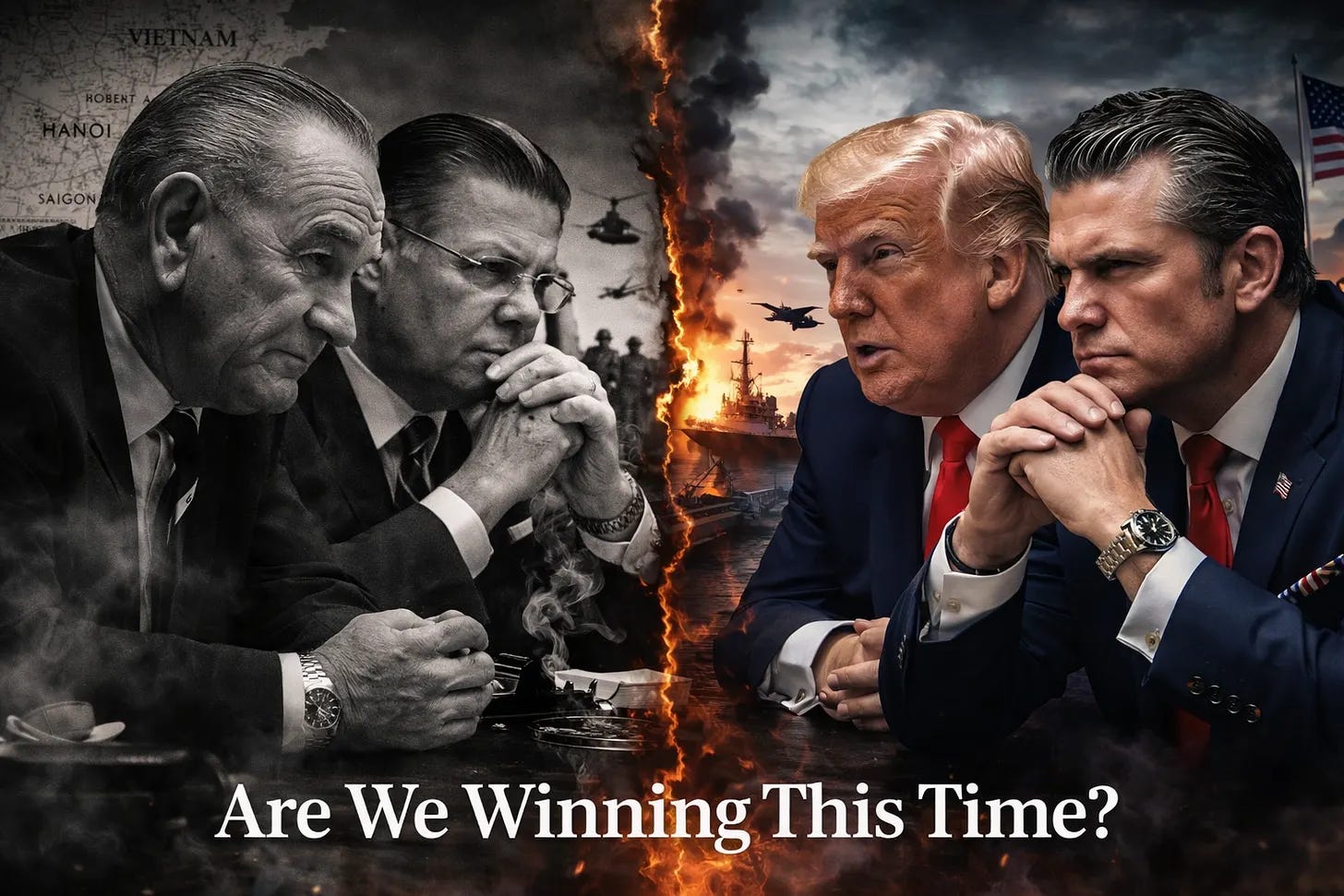
“Never was so much false arithmetic employed on any subject as that which has been employed to persuade nations that it is their interest to engage in war.” Dear Friends, I originally shared this piece on March 27th, when the Open Society had fewer than half as many readers as it does today. When I revisited it recently, I was struck by how much of what then seemed like warning or speculation now resembles where we have arrived. I wish I could say the argument had aged poorly, but when it comes to war, being right about a warning offers little comfort. With so many new readers joining us since March, I wanted to share the original again. What follows is the piece exactly as it appeared five months ago, because I believe dates matter. I don’t believe many of us knew then where a war with Iran might lead. Read it with that in mind, and I hope you find it enlightening and worth revisiting. Originally published March 27, 2026Dear Friends, I was listening to an interview earlier this week in which Richard Haass, a longtime U.S. diplomat and former president of the Council on Foreign Relations, said something that should make every student of history pause. As the Trump administration continues to claim we are “winning” in Iran by pointing to successful strikes and degraded capabilities, Haass made a comparison that cuts straight through the optimism. He said it sounded like Vietnam, especially Robert McNamara’s Pentagon in the 1960s, when success was judged by body counts and targets destroyed, even though the situation on the ground was going the opposite way. Now consider what we’re being told today. U.S. Central Command reports high operational success, with strike effectiveness frequently cited at 85-90 percent, as well as naval degradation across key Gulf assets and repeated disruption of air defenses and command centers. On paper, it looks decisive and controlled, which is exactly why it warrants scrutiny. Iran is not a typical opponent that falls apart when infrastructure is damaged, and treating it like Iraq in 2003 would be a major mistake. The Iranian Revolutionary Guard Corps is decentralized, integrated throughout society, layered via proxies, and hardened by decades of sanctions and conflict. This means command nodes can be targeted without destroying the entire system. This is the same structural challenge the United States faced in Vietnam, where the Viet Cong absorbed pressure, adapted quickly, and kept operating despite heavy losses. Iran reflects that same idea of endurance, reinforced by its eight-year war with Iraq, which shows that its leadership and elite forces are built to last rather than fall apart, making quick regime change through strikes historically unlikely. While focus stays on what’s being destroyed, Iran is shaping the conflict in the areas that matter most. This is an asymmetric war, and Iran already has leverage in that area. The potential disruption of the Strait of Hormuz, which accounts for about 20 percent of the world’s oil supply, caused immediate shocks in global energy markets. This led to higher oil prices, increased shipping risks, and raised insurance costs, all of which directly create economic pressure both domestically and internationally. That pressure is not secondary to the conflict; it is central to it. Simultaneously, Iran’s regional networks ensure that the conflict cannot stay contained. Gulf partners aligned with the United States are vulnerable, and the pressure goes beyond military measures to systemic disruption. The Strait of Hormuz is just one choke point; the Bab al-Mandeb could also be disrupted by Houthi forces aligned with Tehran. These groups have already targeted commercial shipping in the Red Sea, putting two of the world’s most vital trade routes under joint pressure and hastening a war of attrition focused on endurance rather than territory. This is where the warning becomes obvious. In Vietnam, the United States gauged success by activity, even as its broader strategic position worsened, and the figures looked impressive until it became clear they were measuring motion rather than progress. That is the current risk. What is absent is the most vital component of any conflict: a clear end state. Initially, the discourse focused on regime change, aimed at dismantling the system, its leadership, and capabilities. Currently, the rhetoric has shifted to seeking a “deal,” but it’s never specified who that is with…whether it’s the regime that was previously targeted for dismantling, its remaining military leaders, or an undefined intermediary. That contradiction matters because it reveals the core problem. There is no clear objective that the American people can see, measure, or understand. If the goal is regime change, then state it and outline the path. If the goal is negotiation, then specify the terms and the counterpart. If it is something else entirely, then explain it. Currently, clarity is lacking. Instead, there’s movement without clear direction, escalation without clear purpose, and messaging that changes more quickly than the strategy guiding it. And when a nation goes to war without clearly defining who it is fighting, what outcome it aims for, and how it plans to end it, the war does not determine the outcome. The war begins to shape us. In that environment, time is working against us. As costs rise and markets react, allies may feel the strain, while larger powers like China and Russia monitor opportunities arising from stretched resources and divided attention. This situation often causes regional conflicts to escalate into much harder-to-manage challenges. The real question isn’t whether targets are being hit, but whether we’re confusing numbers with progress, as in Vietnam; confusing early success with lasting advantage; and conflating bombing and counterinsurgency activity with true strategy. If that mistake is being made, this will not end cleanly. It will end the way these wars always do, slowly, at enormous cost, and with the realization that our ability to strike was never the issue. The real mistake was getting involved in a war without a clear end-state goal, because without a specific victory in mind, the war never truly ends; it just keeps draining blood and resources... bringing back the painful echoes of 1965. Vivat Constitution! P.S. If this piece gave you something worth carrying beyond the page, kindly consider sharing it and subscribing to the Open Society, either for free or as a paid member; cancel anytime. Paid members help sustain the independent research behind this work and keep these stories of history, civics, and our Republic free and available to everyone. |
L.C. Francis Open Society for History & Civics
Author and historian connecting America’s past to the forces shaping our Republic today. Evidence-driven essays on history, civics, democracy, and public life for readers who believe understanding the past is essential to protecting the future.
“Having now finished the work assigned me, I retire from the great theatre of Action.”— George Washington, December 23, 1783 Dear Friends, Let me take you on a brief journey to Annapolis, Maryland, into an afternoon that might reveal more about the spirit of our Republic than almost any battlefield from the Revolution. It was December 23, 1783. The war had ended, and the British had officially recognized American independence. That day, George Washington arrived at the Maryland State House...
“I then thought, and still think, that it was an effort of genius.”— George Washington, 1785 Dear Friends, Exactly 250 years ago this week, a man named Sergeant Ezra Lee climbed into a wooden oak vessel barely larger than a walnut shell, secured the brass hatch above him, and slipped beneath the dark tidal waters of New York Harbor. Above him, the Royal Navy loomed. Ezra Lee’s expedition followed Washington’s army, which had suffered a devastating defeat on Long Island; Manhattan was in...
“Security against foreign danger is one of the primitive objects of civil society.”— James Madison, Federalist No. 41 Dear Friends, By the time most of us enjoy our first cup of coffee this Sunday morning, roughly 1.7 million voters in the eastern German state of Saxony-Anhalt will already be casting their ballots in an election that could tell us a great deal about Europe’s future. As many of us learned in our history classes, Germany’s post-Nazi reintroduction to the international community...