Author and historian connecting America’s past to the forces shaping our Republic today. Evidence-driven essays on history, civics, democracy, and public life for readers who believe understanding the past is essential to protecting the future.
The Assurance We Still Need
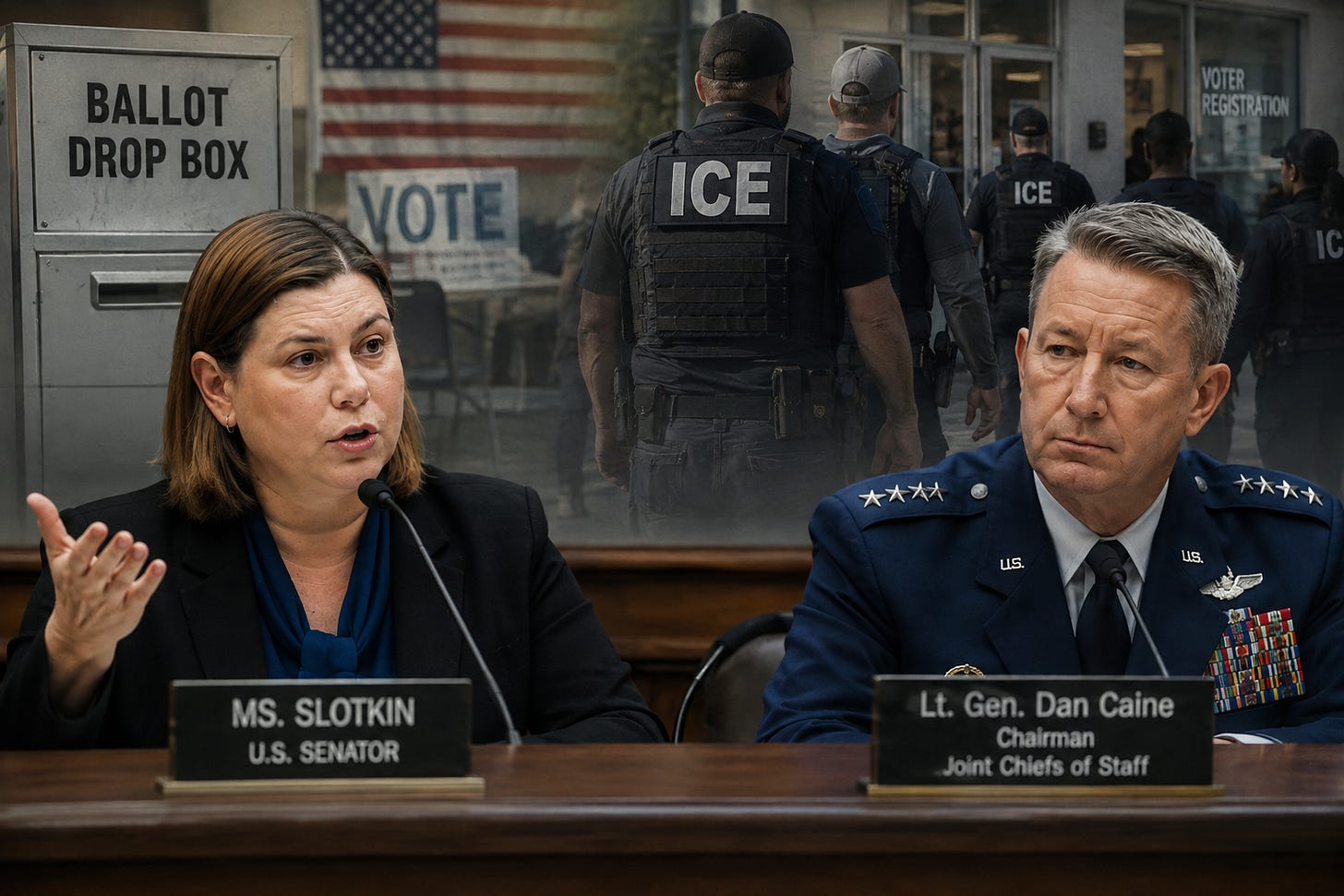
“Where an excess of power prevails, property of no sort is duly respected.” Dear Friends, There is a particular kind of silence that falls over our nation when a question has hung in the room far too long. Everyone can see it, everyone knows it’s there, but no one quite wants to be the first to point out the white elephant standing in plain sight. That was the feeling around Senator Elissa Slotkin’s question to Gen. Dan Caine. She finally asked aloud what many Americans had been quietly wondering: would the United States military be kept away from the polls this November? That was the atmosphere surrounding Senator Elissa Slotkin’s question to Gen. Dan Caine, the Chairman of the Joint Chiefs of Staff. She was not asking about troop levels overseas or a new weapons system. She wanted to know whether our military would be kept away from polling places in November and whether federal troops or federalized National Guard personnel would be used to seize ballots, voting machines, or other election materials. Caine’s answer was reassuring. In writing, he confirmed that the Joint Force has no plans to take any of those actions. For a moment, it felt like the kind of answer that could let the country exhale. Then came the harder question: how far did his assurance really reach? More importantly, Caine reminded Washington of something that should never have been controversial: election administration and security remain fundamentally the responsibility of state and local officials. I welcome his answer, but after reading his letter, I kept returning to a troubling distinction. Caine spoke for the Joint Force, not for the Department of Homeland Security, ICE, the FBI, the Justice Department, or any component of the National Guard. Nor did his letter erase the extraordinary emergency authorities that remain available to a president. Slotkin apparently reached the same conclusion. On Wednesday, she sent another round of letters to Attorney General Todd Blanche, Homeland Security Secretary Markwayne Mullin, FBI Director Kash Patel, and National Guard chief Gen. Steven Nordhaus, requesting the same basic commitment from each. There was a reason she had to ask. Mullin has already refused to give the categorical answer Caine gave. He says ICE will not patrol polling places, but he has left open the possibility that agents could appear there in response to a “specific threat” or while serving a warrant for someone they are pursuing. The question isn’t whether federal agents should overlook an active shooter, a bomb threat, or any real threat to human life. Of course, they shouldn’t. The broader question is who gets to define the threat, how broadly that definition can be stretched, and what happens when the administration defining the emergency also has a political interest in the election taking place around it. That question becomes much harder to dismiss when we consider what Washington is already doing. By this spring, the Justice Department had sued 30 states and the District of Columbia to obtain access to their statewide voter-registration records. DOJ has demanded voter files containing sensitive identifying information and argued that those records may be shared with Homeland Security for comparison with federal databases. Some states have complied, while others have challenged the demands in court. Then DOJ’s own Office of Legal Counsel went further. In May, it concluded that the Justice Department’s statewide voter lists could be shared with Homeland Security Investigations for cross-checking against federal records. That isn’t speculation by an outside critic; it’s the Executive Branch’s own legal position. ICE is now seeking a contractor for something even more consequential: a national system that contains voter-registration and voting-history information from all 50 states. The proposed contract is worth up to $5 million and is intended to support fraud detection and analysis. It’s important to remember that ICE was created to enforce immigration and customs law. Yet weeks before a national election, an agency whose officers may be permitted near polling places under circumstances defined by the administration is also seeking authority to compile nationwide information on who is registered and who has voted. The Oval Office says these efforts are meant to protect election integrity and identify noncitizens who may have registered unlawfully. That is a legitimate responsibility, and federal law already gives prosecutors tools to act when there is evidence of an actual violation. The constitutional issue arises when the usual process is turned around. Instead of beginning with evidence and then looking into a suspect, the government first compiles millions of lawful voters into a federal database. This database then searches the population for any signs that might warrant further investigation. This isn’t targeted enforcement; it’s suspicion spreading across the entire electorate. We’ve already seen another boundary crossed earlier this year. Back in January, FBI agents entered Fulton County, Georgia’s election facility under a federal search warrant tied to the 2020 election. They stayed for more than eight hours and removed 653 boxes of election records, including ballots, absentee-ballot envelopes, tabulator tapes, ballot images, voter rolls, and other election materials. Fulton County officials later said the voting machines themselves weren’t taken. The seizure occurred years after recounts, audits, investigations, and litigation had examined Georgia’s 2020 presidential election results. Of course, our government maintains that the investigation is fully lawful… Fulton County has challenged aspects of the seizure in federal court. Whatever one thinks of that investigation, one fact is no longer theoretical… federal law enforcement officers have already entered a local election facility and removed hundreds of boxes of election materials into federal custody. Now place these developments side by side. The Pentagon says troops will stay away from November’s polling places. DHS won’t categorically rule out ICE’s presence in the area. DOJ has sued 30 states and the District of Columbia over voter files. DOJ’s own lawyers say those records may be shared with DHS. ICE is seeking a nationwide voter-registration and voting-history database. The FBI has already shown that federal agents can seize local election materials through the judicial process. None of those facts proves an effort to manipulate the midterms, and we should not pretend otherwise. But together, they paint a picture of a federal election footprint far larger than most Americans probably realize. Above all of this is presidential emergency authority. Federal law gives presidents substantial power to call National Guard forces into federal service when the U.S. faces invasion or rebellion, or when the President concludes that regular forces cannot enforce federal law. The Insurrection Act provides additional authority to use the militia and armed forces domestically when federal law cannot be enforced through ordinary judicial proceedings. These laws were written for genuine crises. Presidents have used federal military power to enforce constitutional rights when states refused to do so, including protecting Black children integrating public schools during the civil rights era. But the same history teaches another lesson: extraordinary power depends heavily on the judgment of the person who decides that circumstances have become extraordinary. Washington presents an additional complication. The District of Columbia National Guard is unlike any state Guard in America. There’s no governor between it and the federal executive. More than 2,400 soldiers and airmen serve in the D.C. Guard, whose official history describes its commanding general as ultimately subordinate to the President, with activation authority delegated by the Defense Department. None of this means Donald J. Trump can simply order soldiers into polling places. Federal law creates formidable barriers to military interference in elections. Title 18 makes it a crime to bring troops or armed men to polling places except in extraordinarily narrow circumstances. Violators can face up to five years in prison and disqualification from federal office. More importantly, the law also prohibits members of the Armed Forces from intimidating voters, interfering with election officials, determining voter qualifications, or imposing election regulations. Congress explicitly criminalized military interference in voting, rather than leaving it to tradition or presidential discretion. Our concern in 2026, however, goes beyond soldiers because an election can be influenced without a tank outside a school gymnasium. A masked DHS agent standing near a polling place carries federal authority, even though the letters on his vest read ICE rather than ARMY. A national voter database can link information that once sat separately in state systems. A federal search warrant can place local election materials under Washington’s custody without a soldier ever leaving a barracks. Taken together, these developments already reveal a federal election footprint far larger than most Americans realize. Advanced analytics and AI make that footprint even more consequential because voter files, immigration records, investigative databases, and enforcement authorities can now be connected, searched, and analyzed at a scale our older election laws never contemplated. Palantir is one example, but we need to be precise about what the evidence shows. I haven’t found any credible evidence that Palantir is manipulating voting machines, and I won’t suggest otherwise. The public record, however, shows that ICE awarded Palantir more than $86 million this year to modernize and enhance the analytical capabilities of its enforcement case management system. That’s not evidence of election tampering… It’s evidence of something more concrete: the same immigration enforcement apparatus now seeking nationwide voter information already possesses enormously sophisticated tools for combining, managing, and analyzing investigative data. The danger isn’t a cinematic plot in which a computer company secretly changes votes. It’s the concentration of voter information, immigration records, investigative databases, federal law-enforcement authority, large-scale analytics, and emergency powers within the same executive branch. Our election system was deliberately built in the opposite direction. Thousands of jurisdictions, state laws, local officials, bipartisan workers, paper records, testing procedures, audits, and separate chains of custody make our elections frustratingly complicated. That complexity is also a defense because there’s no single switch in Washington that controls an American election, and we should be exceptionally careful about constructing the administrative equivalent of one. When you look at the letter sent from General Caine, he deserves considerable credit for understanding his institution’s place in that arrangement. His letter does more than reassure Senator Slotkin… It sets a standard that every official entrusted with federal coercive power should be willing to meet before November, not after a crisis prompts Washington to test the limits. This is no longer a dispute over a single agency or a hypothetical order. Thirty states and the District of Columbia have faced federal lawsuits over voter records. ICE is considering a voter-data project covering all 50 states. Federal agents removed 653 boxes of election records from Fulton County. ICE already has an analytics system backed by an $86 million Palantir award. More than 2,400 members of the D.C. National Guard fall under a uniquely presidential chain of command. Those facts don’t establish a conspiracy…they establish capacity. And that distinction matters because constitutional guardrails are meant to restrain power before anyone finds a justification for using it. Once an election is underway, some injuries aren’t easily repaired afterward. A voter intimidated into leaving a polling place cannot simply have that moment back. Sensitive information entered into another federal database cannot be made unknown. Election materials taken into federal custody don’t somehow remain locally controlled while the courts spend months deciding whether the seizure was proper. General Caine has drawn one important boundary before November arrives. What remains unanswered is whether the officials who control the other instruments of federal power are prepared to do the same, publicly and unequivocally. That isn’t asking Washington for a favor. It is asking government officials to tell the country, before the votes are cast, where they believe the constitutional limits on their power lie. If they cannot give our country a clear answer before Election Day, then suspicion is no longer the issue. The issue is that the same officials entrusted with extraordinary federal power have chosen to preserve uncertainty about the very moment when their authority is supposed to be submitted to us, the voters. In our Republic, that is not caution… It is power refusing to show its limits. Vivat Constitution! P.S. If this piece gave you something worth carrying beyond the page, kindly consider sharing it and subscribing to the Open Society, either for free or as a paid member; cancel anytime. Paid members help sustain the independent research behind this work and keep these stories of history, civics, and our Republic free and available to everyone. |
L.C. Francis Open Society for History & Civics
Author and historian connecting America’s past to the forces shaping our Republic today. Evidence-driven essays on history, civics, democracy, and public life for readers who believe understanding the past is essential to protecting the future.
“Having now finished the work assigned me, I retire from the great theatre of Action.”— George Washington, December 23, 1783 Dear Friends, Let me take you on a brief journey to Annapolis, Maryland, into an afternoon that might reveal more about the spirit of our Republic than almost any battlefield from the Revolution. It was December 23, 1783. The war had ended, and the British had officially recognized American independence. That day, George Washington arrived at the Maryland State House...
“I then thought, and still think, that it was an effort of genius.”— George Washington, 1785 Dear Friends, Exactly 250 years ago this week, a man named Sergeant Ezra Lee climbed into a wooden oak vessel barely larger than a walnut shell, secured the brass hatch above him, and slipped beneath the dark tidal waters of New York Harbor. Above him, the Royal Navy loomed. Ezra Lee’s expedition followed Washington’s army, which had suffered a devastating defeat on Long Island; Manhattan was in...
“Security against foreign danger is one of the primitive objects of civil society.”— James Madison, Federalist No. 41 Dear Friends, By the time most of us enjoy our first cup of coffee this Sunday morning, roughly 1.7 million voters in the eastern German state of Saxony-Anhalt will already be casting their ballots in an election that could tell us a great deal about Europe’s future. As many of us learned in our history classes, Germany’s post-Nazi reintroduction to the international community...