Author and historian connecting America’s past to the forces shaping our Republic today. Evidence-driven essays on history, civics, democracy, and public life for readers who believe understanding the past is essential to protecting the future.
The Stranger in the Library
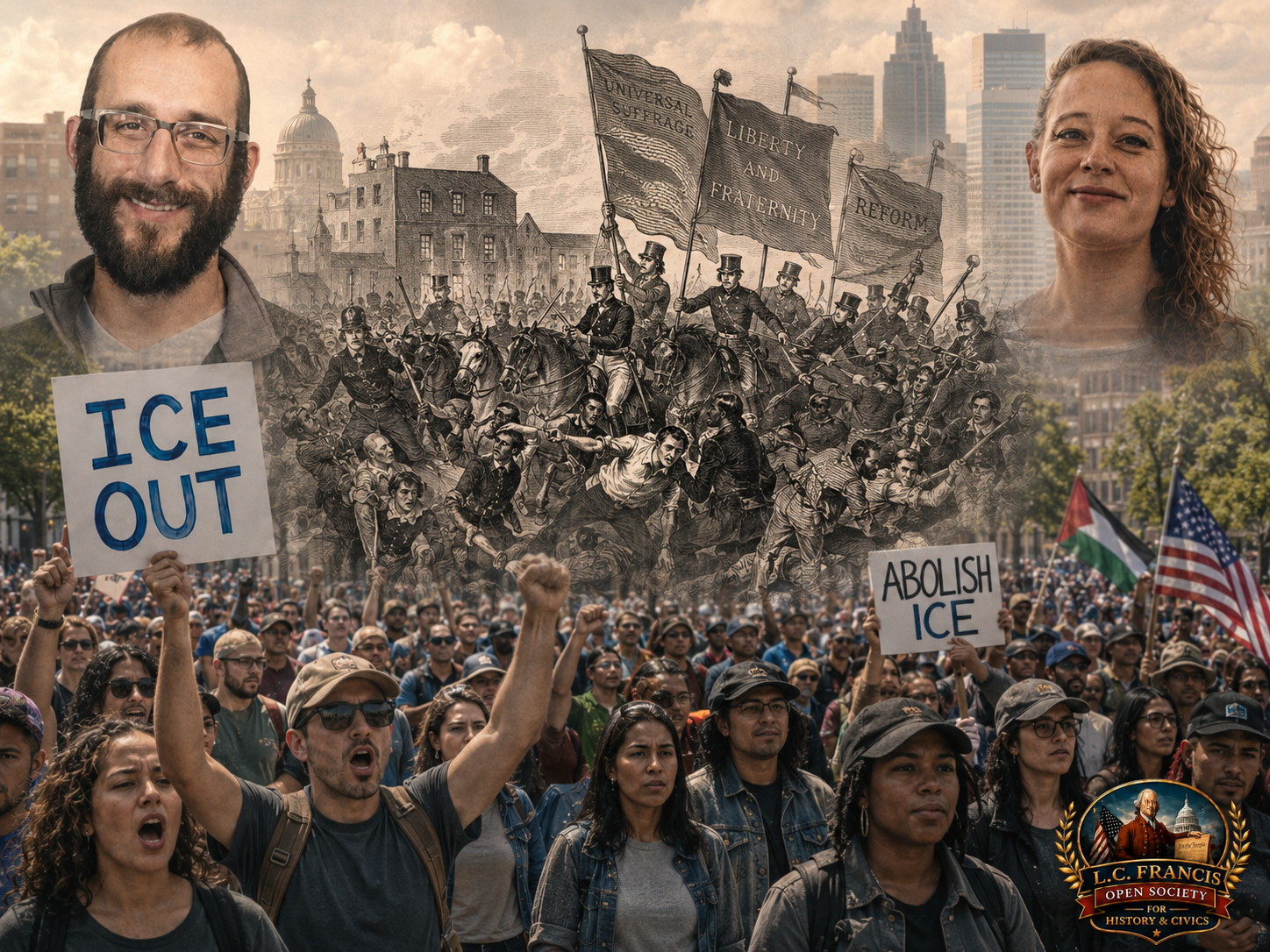
“The censorial power is in the people over the Government, and not in the Government over the people.” Dear Friends, I want to tell you about a story that begins on January 31 of this year, in a public library in Minneapolis. Fellow Americans gathered to discuss protests against ICE in their city. They discussed sit-ins, de-escalation, safety marshals, and designating someone to communicate with police. Sitting among those Minneapolis residents was someone they didn’t recognize: an undercover officer from the Department of Homeland Security, identified in federal records only as “UCA 9833.” When the officer filed a report afterward, even the government’s own agent acknowledged the obvious: the Sunrise Movement was focused on “peaceful” protests. Yet the meeting had become an intelligence collection opportunity for our government. Court records filed on August 13 reveal something far larger. Under an operation called “Puppet Master,” federal agents infiltrated meetings in churches, schools, libraries, and parks during the Trump regime’s immigration crackdown in Minnesota. They reportedly monitored activist chat groups, used license plate numbers from the cars parked outside meeting halls and churches to identify attendees, and obtained years of financial records from certain organizations and labor unions. One Homeland Security presentation titled “The Conspiracy” listed and placed 18 organizations beneath it, ranging from a Minneapolis bicycle collective to the AFL-CIO, the largest federation of unions in the United States. I’ve always argued that our federal government has every right to investigate actual violence, obstruction, or criminal conspiracy. 15 people were charged in June for efforts to impede immigration enforcement. But that’s precisely why these newly released records matter. Law enforcement is supposed to investigate criminal conduct; political association and peaceful assembly are not criminal acts and don’t constitute probable cause. More importantly, belonging to a union, attending a meeting, discussing a sit-in, or criticizing government policy doesn’t erase an American’s First Amendment rights. In fact, during Ronald Reagan’s first term, our government recognized that monitoring our fellow Americans required limits. In 1981, at the height of the Cold War, Reagan signed what became known as Executive Order 12333. The order didn’t prohibit all investigations involving U.S. persons, but it imposed safeguards, required Attorney General-approved procedures, and placed specific restrictions on federal agents’ secret participation in domestic organizations. Those protections existed for a reason: political activity cannot become suspicious simply because the government dislikes the politics. That is what makes Operation Puppet Master so difficult to dismiss as routine law enforcement. We must never forget that Federal agents entered churches, schools, libraries, and parks; monitored private communications; recorded license plates; followed financial trails; and placed American organizations under a government designation called “The Conspiracy.” Before Washington tells us there is nothing to see here and to move on, it owes the American people a simple answer: what criminal conduct justified placing a federal undercover agent in that room? Today, August 16 should make us especially uncomfortable. I’d like to take you back 207 years, to August 16, 1819, when roughly 60,000 people gathered at St. Peter’s Field in Manchester, England, to seek parliamentary reform. Mind you that British authorities already feared the country’s growing reform movement. Magistrates ordered the arrest of Henry Hunt, the featured speaker, and cavalry moved into the crowd with sabers drawn. An estimated 18 people were killed and as many as 700 injured. The British government’s answer to the Peterloo Massacre wasn’t greater representation; Parliament responded with the Six Acts, designed in part to suppress large meetings demanding political reform. I’m not going to argue that Peterloo and Minneapolis are equivalent, and we’d be cheapening history by pretending they are. However, Peterloo teaches us something far more useful than a forced comparison: what governments can begin to see when political dissent frightens them. Suddenly, a meeting becomes a threat, an organization becomes a conspiracy, and the people asking questions become targets of surveillance. 25% off to Upgrade Before Midterms James Madison understood the danger from the opposite direction. In 1794, while defending the right of political societies to criticize those in power, he told the House of Representatives, “The censorial power is in the people over the Government, and not in the Government over the people.” That statement goes directly to the heart of what these records reveal. In our Republic, citizens watch their government, not the other way around. Our government doesn’t get to turn peaceful organizing, lawful protest, or political opposition into grounds for suspicion simply because the citizen is exercising those constitutionally protected rights that oppose the man sitting in the White House… The First Amendment shields dissent precisely when those in power would rather not hear it. Peterloo ended with sabers, but the constitutional danger begins much earlier, when the government starts treating an inalienable right as suspicious behavior. Peaceful association should never become an intelligence problem. Our government doesn’t have to outlaw protest to weaken it. It only has to make ordinary Americans hesitate before entering a library, church, union hall, or public meeting, wondering whether someone in Washington is recording their name, tracing their license plate, examining their finances, or quietly placing them under a heading called “The Conspiracy.” Our First Amendment wasn’t written so We the People could speak and assemble only after the government deemed them harmless… It was written because the government doesn’t get to make that decision. In Minneapolis, that principle is no longer academic. Renée Good, a mother of three, and Alex Pretti, an intensive-care nurse at the local VA hospital, were both 37 years old, with an entire life ahead of them, when masked ICE agents gunned them down. Their deaths sent our fellow Americans into the streets, demanding answers from their own government. And then our government began watching some of the people who were asking the simple questions about ICE activities. That should make every American furious. Bottom line: citizens saw their neighbors killed; in response, they gathered peacefully to demand transparency and accountability but only discovered that federal agents were attending their meetings, monitoring communications, recording license plates, and compiling case files on local community organizations involved in the protests. If that makes even one American think twice before entering a church basement, a union hall, a library meeting, or a lawful protest, our government has already stripped them of a constitutional liberty afforded to them. The Trump regime doesn’t need to repeal the First Amendment; it just needs to weaken it with a thousand razor cuts; continue to harass and coerce folks to the point that it makes Americans afraid to use it. The moment a citizen wonders whether entering a library, union hall, or peaceful protest will put their name in a federal case file, our government has already stolen a piece of that freedom. Our constitutional Republic should never intimidate its citizens into silence, drive them away from the Public Square, or make them fear the consequences of demanding answers from those in power. When peaceful Americans become subjects of government surveillance simply for exercising their constitutional rights, the danger to liberty is no longer coming from the protesters in the street; it is coming from the government keeping files on them. So, our answer cannot simply be to stay at home. Congress should demand the legal justification, scope, and full accounting for Operation Puppet Master, and we need to determine whether individuals were targeted for criminal activity or protected political expression. Meanwhile, the rest of us should continue visiting our libraries, churches, union halls, and public spaces. Remember, our First Amendment survives only when free people are willing to use it. If surveillance is intended to make Americans disappear from public life, then our response must be unmistakable: We the People are not going anywhere… Vivat Constitution! If this piece made you pause, think, or see the First Amendment a little differently, please consider subscribing to the Open Society and sharing it with someone who should read it, too. Paid member support makes that research, independence, and civic mission possible and allows Open Society to keep this work accessible to the wider public. Sometimes the most useful thing we can do for the Republic is simply ensure an important argument reaches one more citizen. |
L.C. Francis Open Society for History & Civics
Author and historian connecting America’s past to the forces shaping our Republic today. Evidence-driven essays on history, civics, democracy, and public life for readers who believe understanding the past is essential to protecting the future.
“A fondness for power is implanted in most men, and it is natural to abuse it when acquired.”— Alexander Hamilton, The Farmer Refuted, 1775 Dear Friends, I rarely republish an essay, but last night I revisited something I wrote on December 21, 2025, when Donald J. Trump first tried to graft his name onto the John F. Kennedy Center for the Performing Arts. I called it “Names Matter: Trump’s Hostile Takeover.” At the time, I argued that this was about far more than letters on a building. It was...
This is a test of the new Open Society sending address.
“The aim of every political constitution is, or ought to be, first to obtain for rulers men who possess most wisdom to discern, and most virtue to pursue, the common good of the society.”— James Madison, Federalist No. 57 Dear Friends, Over the years, I’ve learned to enjoy not just reading about the Sons of Liberty and the 18th-century Founders; I often explore the lives of more recent presidents as well. I’m mainly interested not only in their major achievements upon reaching the White House...