Author and historian connecting America’s past to the forces shaping our Republic today. Evidence-driven essays on history, civics, democracy, and public life for readers who believe understanding the past is essential to protecting the future.
The Price of Plenty: The Children of Cotulla
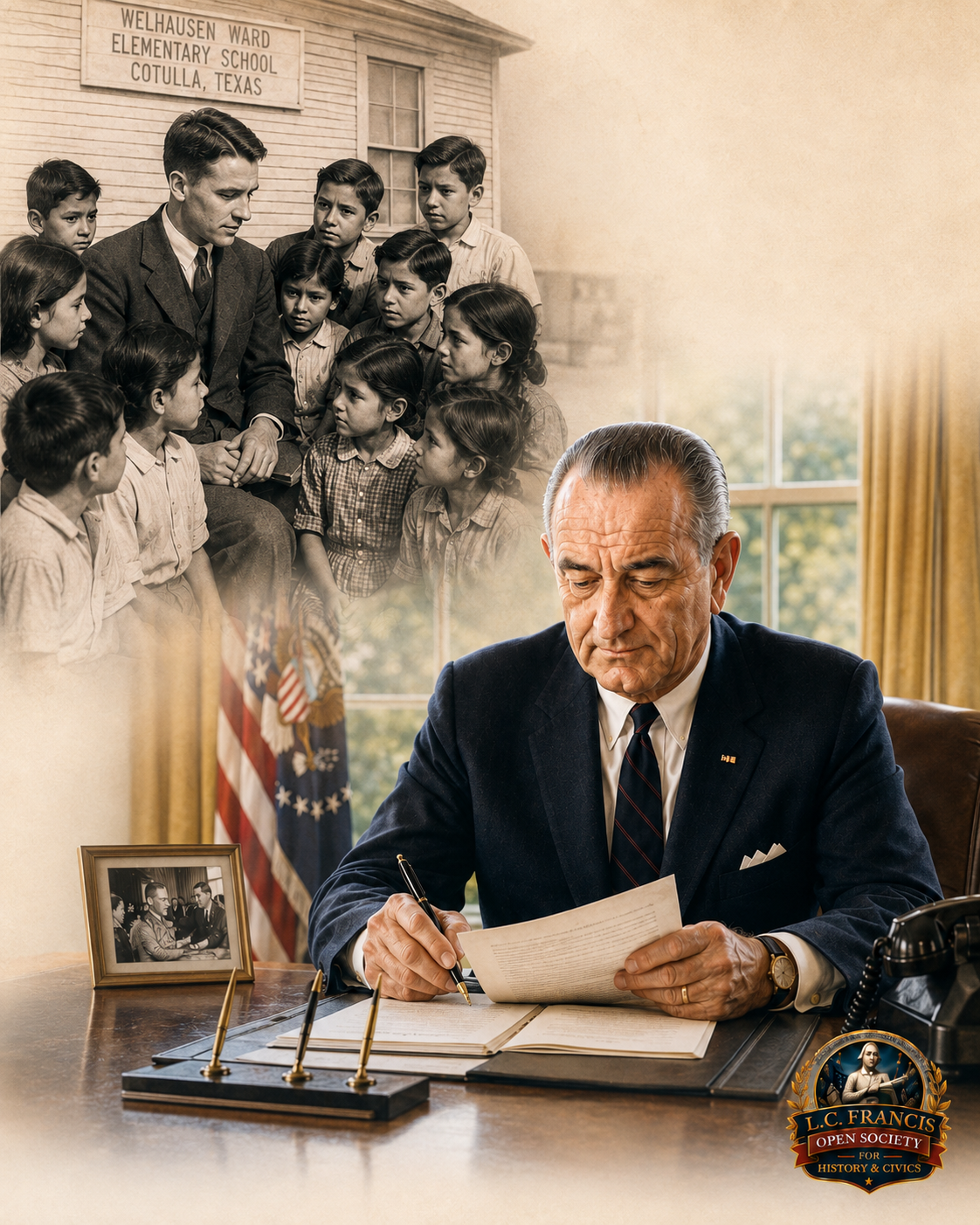
“The aim of every political constitution is, or ought to be, first to obtain for rulers men who possess most wisdom to discern, and most virtue to pursue, the common good of the society.” Dear Friends, Over the years, I’ve learned to enjoy not just reading about the Sons of Liberty and the 18th-century Founders; I often explore the lives of more recent presidents as well. I’m mainly interested not only in their major achievements upon reaching the White House but also in the small moments that shaped their adolescence and early adulthood, with a particular focus on their beliefs about the role of our government. Today, 27 August, is Lyndon Baines Johnson’s birthday. While researching LBJ further, I came across the story of a 20-year-old college student who arrived in 1928 at a small, segregated school in Cotulla, Texas, to work and pay for his education. Welhausen Ward Elementary served poor Mexican-American children. Johnson taught fifth, sixth, and seventh grades, served as principal, and oversaw activities. He quickly discovered that many of his students arrived at school hungry. The school had little, so LBJ spent part of his first paycheck on baseball gloves, bats, basketballs, and other equipment, and, moreover, he helped organize food for children who couldn’t be expected to learn on an empty stomach. Before Washington taught Lyndon Johnson how power worked, Cotulla taught him what powerlessness and vulnerability looked like. Nearly four decades later, on March 15, 1965, just eight days after Alabama state troopers attacked peaceful marchers on Selma’s Edmund Pettus Bridge, fracturing the skull of 25-year-old John Lewis, President Johnson stood before a joint session of Congress and remembered Cotulla’s hungry children. “My students were poor, and they often came to class without breakfast, hungry,” he said, recalling how he had walked home wishing he could do more for them. By then, Johnson had signed the Food Stamp Act of 1964, making the federal program permanent. In 1965, major federal aid for schools serving disadvantaged children arrived, and the following year he signed the Child Nutrition Act, which established the School Breakfast Program as a pilot and expanded federal nutrition assistance. Vietnam ensures that no serious history of Johnson should become sentimental, but Cotulla helps explain something important about his presidency: when he finally had the power he had lacked as a young teacher, he remembered the children who had once sat hungry before him. Nearly a century later, America still has children carrying that burden into classrooms. The Department of Agriculture reports that in 2024, 7.3 million children lived in households where they themselves experienced food insecurity. Of those, 751,000 lived in households where at least one child’s eating was reduced or disrupted because the family lacked enough money or resources for food. Yet Congress and President Trump enacted Public Law 119-21, the One Big Beautiful Bill Act. Supporters argue that adults receiving assistance should work when able and that taxpayers deserve accountability. Fair enough. But accountability does not change Congress’s arithmetic: the Congressional Budget Office estimates that expanded SNAP work requirements will, on average, reduce participation by about 2.4 million people each month over the next decade. At the same time, other provisions are expected to reduce benefits and child nutrition subsidies. The fiscal argument becomes even harder to defend when we consider the law as a whole. CBO estimates that it will reduce federal SNAP spending by roughly $187 billion over ten years, while reducing federal revenues by about $4.5 trillion. It cuts about $1.1 trillion in direct spending yet still adds roughly $3.4 trillion to federal deficits before the additional interest on that borrowing is counted. For every dollar the law is projected to remove from SNAP, roughly $24 in federal revenue is lost. Congress did not balance the budget; instead, it chose where to apply austerity measures. Now consider who lives on the other side of that ledger. Federal Reserve data show that the wealthiest one-tenth of 1% of American households hold about $25 trillion. The entire bottom half of the country holds roughly $4.3 trillion. Expanding the lens to the top 1%, their wealth totals about $55 trillion, nearly thirteen times what the poorer half of America owns altogether. Between the first quarter of 2025 and the first quarter of 2026, the wealth of the top 1% increased by approximately $5.2 trillion. That one-year increase was roughly twenty-eight times the total SNAP reductions Congress has enacted over the entire decade. Nobody needs to apologize for succeeding in America, and private wealth cannot be treated as a checking account for Washington. But neither should anyone insult the intelligence of an American family by pretending that a nation capable of generating trillions in additional wealth at the top somehow discovered fiscal necessity when a poor child reached for breakfast. Our tax history makes the choice even clearer. In 1965, when Johnson expanded food and educational assistance, the highest statutory individual income-tax rate was 70%, and the top corporate rate was 48%. Today, the highest individual rate is 37%, while corporations generally pay a federal rate of 21%. Last year, Congress made the current individual rate structure permanent. No responsible person should suggest simply photocopying the 1965 tax code and imposing it on the 2026 economy. But surely a country facing enormous deficits can ask whether the first place to look for savings should be a child’s dinner plate, while extraordinarily profitable corporations and households with immense concentrations of wealth are asked to shoulder dramatically less, at the statutory margin, than their counterparts did under Johnson. There’s a way forward that doesn’t require punishing success, and I’ve always argued that Congress doesn’t need to punish success to restore some balance. It can ask the wealthiest Americans and the most profitable corporations to contribute more, close tax advantages that favor wealth over wages, and use part of that revenue to reduce the national debt rather than cut food assistance for families already struggling to get by. That would be fiscal responsibility worthy of the name. Cutting food assistance while simultaneously surrendering trillions in revenue and borrowing trillions more is not fiscal conservatism; it is a decision about whose sacrifice matters and whose comfort does not. This is why I keep seeing those children in Cotulla. Johnson met young Americans whose opportunities were already narrowing before they had even made a single economic choice of their own, and he understood that hunger was not a moral failing in a fifth-grader… It was hunger, imposed on a child by circumstances that adults had the power either to alleviate or to ignore. We possess that power now, along with wealth LBJ could scarcely have imagined. We know that 7.3 million children live in food-insecure households; we know where the nation’s wealth has accumulated; and we know that Congress has chosen to add trillions to our national debt while reducing food assistance for ordinary Americans. Future historians won’t have to wonder whether America could afford to feed its children. The records will show that we’re the richest nation of our age, that extraordinary private wealth was accumulating by the trillions, and that our government nevertheless decided that fiscal discipline should begin with working families, who are already counting dollars in the grocery aisle. Reading through some of Johnson’s memos, I found an excerpt in which he described walking home from Welhausen Ward Elementary, wishing he had the power to confront the childhood hunger and deprivation he had witnessed in Cotulla. Decades later, when that power finally came, he remembered those children and used the presidency to expand opportunity for millions of Americans. Today, we are sliding into a Neo-Gilded Age, where the wealthiest 0.1% holds roughly $25 trillion, while Washington spends $400 million on a White House ballroom, buries a security bunker beneath it, and plans a 250-foot triumphal arch facing Arlington, even as Congress cuts food aid in a nation where 7.3 million children live with food insecurity. There’s nothing inevitable about this, and certainly nothing fiscally conservative about it. It is oligarchic excess laid bare against childhood hunger, with White House spectacles, gold-sprayed grandeur, tax advantages for wealthy donors, and an Executive Branch increasingly entangled with World Liberty Financial, where Trump-family interests, foreign money, cryptocurrency, and federal power now blur into a single, profitable enterprise. Meanwhile, the Oval Office keeps telling struggling families that sacrifice must begin at the checkout counter, even as an affordability crisis drives up the costs of healthcare premiums, rent and housing, insurance, utilities, and the basic cost of simply staying afloat. The obscenity and corruption of our new Gilded Age is not that America lacks the wealth to feed its children, but that we’ve amassed enough wealth to know better and enough indifference to let families sink under the cost-of-living crisis. At the same time, the wealthiest 1% hold roughly $55 trillion, while millions of children still rely on school meals because there simply isn’t enough food at home. CBO estimates that the Big Beautiful Bill will reduce child-nutrition subsidies for about 96,000 children each month. Frankly, a nation as wealthy as ours, capable of launching humans into space, should be ashamed that we still cannot guarantee our own children enough to eat… Hunger in America is no longer a failure of money or resources; it is a failure of national will. Vivat Constitution! P.S. If this piece gave you something worth carrying beyond the page, kindly consider sharing it and subscribing to the Open Society, either for free or for paid membership; cancel anytime. Paid members help sustain the independent research behind this work and keep these stories of history, civics, and our Republic free and available to readers who still believe that child hunger in America is a national travesty. |
L.C. Francis Open Society for History & Civics
Author and historian connecting America’s past to the forces shaping our Republic today. Evidence-driven essays on history, civics, democracy, and public life for readers who believe understanding the past is essential to protecting the future.
“A fondness for power is implanted in most men, and it is natural to abuse it when acquired.”— Alexander Hamilton, The Farmer Refuted, 1775 Dear Friends, I rarely republish an essay, but last night I revisited something I wrote on December 21, 2025, when Donald J. Trump first tried to graft his name onto the John F. Kennedy Center for the Performing Arts. I called it “Names Matter: Trump’s Hostile Takeover.” At the time, I argued that this was about far more than letters on a building. It was...
This is a test of the new Open Society sending address.
“By degrees, the people are brought to consider the soldiery not only as their protectors, but as their superiors.”—Alexander Hamilton, Federalist No. 8, 1787. Dear Friends, I was following the back-and-forth this week between members of the United States Senate and our civilian defense leadership when one exchange stopped me cold in my tracks. In a government built on checks, competing powers, and occasionally sharp political confrontation, Senators ask difficult questions of cabinet...