Author and historian connecting America’s past to the forces shaping our Republic today. Evidence-driven essays on history, civics, democracy, and public life for readers who believe understanding the past is essential to protecting the future.
The Republic Is Not His Monument: Trump’s Hostile Takeover, Revisited
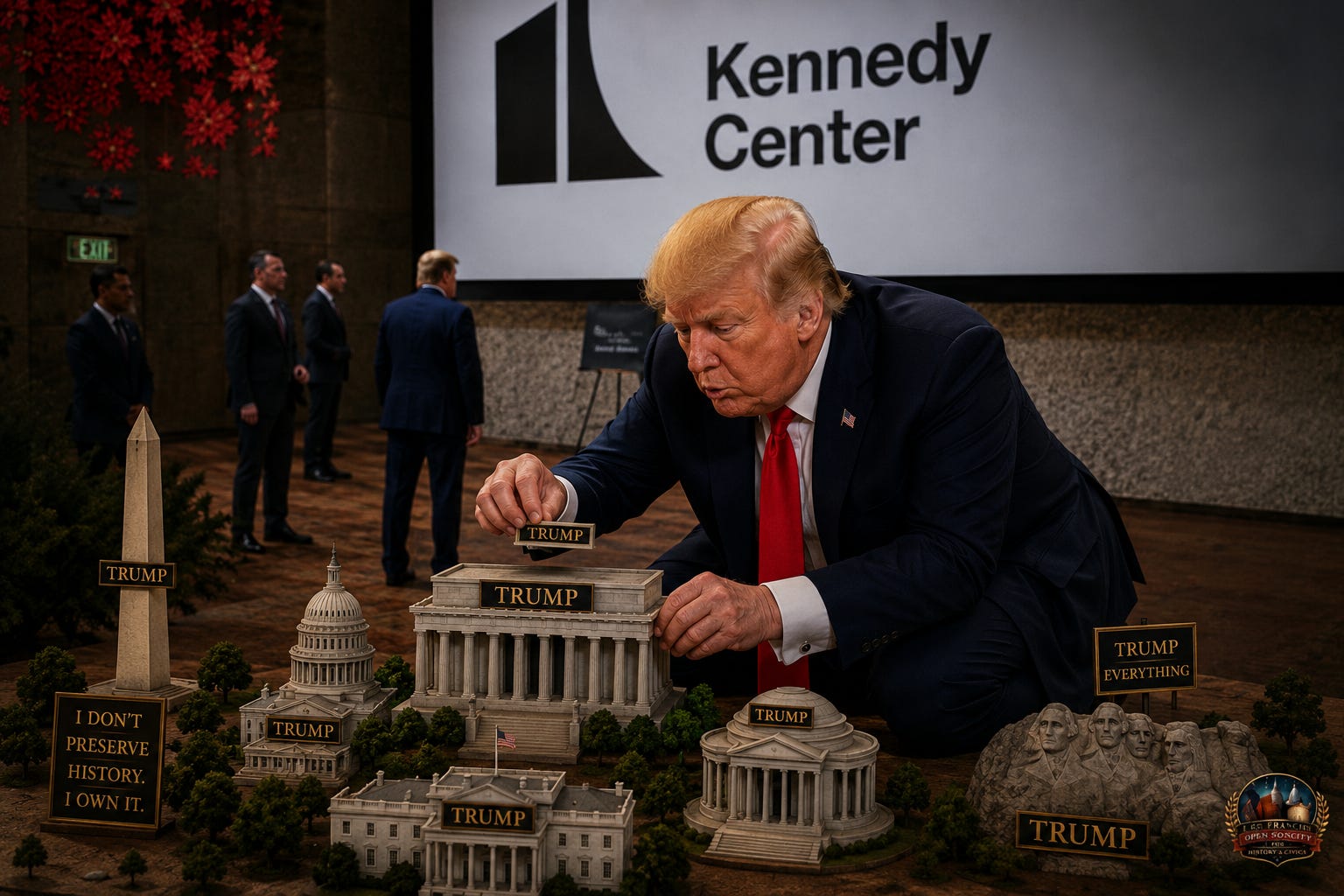 “A fondness for power is implanted in most men, and it is natural to abuse it when acquired.” Dear Friends, I rarely republish an essay, but last night I revisited something I wrote on December 21, 2025, when Donald J. Trump first tried to graft his name onto the John F. Kennedy Center for the Performing Arts. I called it “Names Matter: Trump’s Hostile Takeover.” At the time, I argued that this was about far more than letters on a building. It was about whether a president could begin treating our national institutions and shared memory as personal property. Then, on June 1st of this year, after a federal judge ordered Donald J. Trump’s name removed from the Kennedy Center, I returned to the story in “See? It Wasn’t That Hard. The White House Is Next.” For a brief moment, the principle seemed almost embarrassingly simple. Congress had created and named the memorial, and a president, even one surrounded by a compliant board of sycophants, could not simply rewrite that history just because he wanted his name above the door. Yet, here we are once again. Donald J. Trump’s handpicked board is once more searching for a way to put his name on the Kennedy Center, this time through new language crediting him with its restoration and renovation and by placing his name on the surrounding plaza. In other words, the matter is back before the same federal judge. Meanwhile, the Trump administration has raised the possibility that if the aging building cannot be adequately repaired and financed, demolition could eventually become an option. I reread my December essay, expecting it to feel dated. Instead, what bothered me was how little I would need to change. As many of you know, I was fortunate enough to have worked for John Kennedy’s younger brother, Senator Edward “Ted” M. Kennedy. Whatever one thinks of that family or its politics, those years left me with a lasting understanding of what the Kennedy name meant to millions of Americans. It wasn’t simply a political brand. It had become intertwined with public service, sacrifice, ongoing tragedy, and an imperfect yet enduring belief that government could still ask of us more than we could take from it. That’s why watching the Kennedy Center treated as available real estate for another president’s personal branding landed in my chest before it reached my head. The Kennedy Center is obviously not a casino, hotel, golf course, or any other piece of real estate awaiting someone’s name to be bolted above the entrance. Yet for a man whose worldview is built around transactions, branding, and the belief that nearly everything has a price, the distinction between public stewardship and private possession seems increasingly meaningless. That’s precisely the danger: once the presidency begins treating our national inheritance as another asset to be acquired, renamed, or discarded, nothing held in common is safe from the table. We must never lose sight of the fact that after Kennedy’s assassination, Congress designated it the John F. Kennedy Center for the Performing Arts as a living national memorial. Its name exists because the representatives of the American people placed it there… That distinction matters. The argument keeps swirling in my head, and it’s important to repeat that public institutions do not become the president’s personal property, even temporarily entrusted with their care. The Office of the President inherits them, administers them, protects them, perhaps improves them, and eventually hands them to his successor… He doesn’t own them. As long as anyone can remember, Donald J. Trump has spent much of his adult life putting his name on buildings, products, businesses, and ventures. In private enterprise, that’s his prerogative. But the habits of private ownership take on a very different meaning when carried into the presidency. In essence, winning an election doesn’t confer naming rights to the American inheritance. That boundary is one of the more modest protections of Republican government. Our history offers many warnings about what happens when presidents, for some peculiar reason, confuse political victory with personal entitlement. For example, Andrew Jackson helped turn federal appointments into an enormous patronage system in which political loyalty became currency. A century later, Richard Nixon tried to bend federal agencies to his own political survival. Their circumstances were obviously different, but the underlying danger was quite familiar. Public institutions begin to decay when they’re expected to serve the individual who occupies the office rather than the country that created them. The Kennedy Center dispute belongs to the same family of questions. John F. Kennedy served in the Navy, commanded PT-109 in the Pacific, nearly died during the war, and lived with the consequences of those injuries for the rest of his life. Whatever judgment history ultimately reaches about his presidency, Congress chose his name for that memorial after his assassination because the country wanted something enduring to outlast the political moment. A later president doesn’t get to dilute that decision simply because he holds power today. That is why the court ruling mattered so much when I wrote “See? It Wasn’t That Hard.” Someone challenged the government, a judge examined the law, and the president clearly lost. It wasn’t revolutionary, and that was its beauty. Basically, constitutional government worked because somebody insisted that the boundaries still meant something. Now those boundaries are being tested again, but with more carefully chosen words. The lawyers may argue that recognizing Donald J. Trump for “restoring and renovating” the building is technically distinct from renaming the Kennedy Center itself. They can spend months parsing the language. The larger civic question requires far fewer words… How much of our common inheritance should any president be permitted to remake around himself? This isn’t about feeling nostalgic for Camelot, nor are we claiming that the Kennedy family owns the building. They don’t own it. The American people do, and that is exactly the point. Our Republic relies on institutions, laws, records, memorials, and traditions that are bigger than any individual politician. When presidents start seeing these as personal possessions rather than as a public trust, the boundary between serving the public and pursuing personal gain is forever blurred. And that is why this seemingly minor argument over a name deserves our attention… Names matter because memory matters. The letters attached to a national institution tell future generations whom the country chose to remember and why. They should not be rewritten to suit the vanity, wealth, political power, or appetite for immortality of whoever happens to control Washington at the moment. I believed it when I wrote it in December, and I believed it again when a federal judge ordered Donald J. Trump’s name removed. Now I am more determined than ever to direct our time, attention, and resources to the preservation organizations already fighting this battle. The lesson is no longer theoretical. If we fail to defend the line between public trust and personal possession, he will keep testing how far our laws, our institutions, and our Constitution can be bent until nothing he considers beyond his reach is left. Back in May, our Representative from Ohio, Joyce Beatty, showed what real resistance looks like. When Donald J. Trump’s board of sycophants tried to put his name on the Kennedy Center, she didn’t issue another forgettable statement and move on. She went to court and won. Now, as Donald J. Trump’s allies try again, she is back in court, while preservation groups are fighting to keep the building from being altered or demolished without the legal protections meant to safeguard our national landmarks. They need more than our agreement… They need our support, our attention, and, when possible, our contributions. The Kennedy Center does not belong to Donald J. Trump, nor did it ever belong to John F. Kennedy. It belongs to our Republic that chose to preserve Kennedy’s memory there. We the People now decide whether that inheritance survives intact or whether a temporary occupant of our Oval Office gets to carve himself into something that was never his to own. Vivat Constitution! P.S. If this piece gave you something worth carrying beyond the page, kindly consider sharing it and subscribing to the Open Society, either for free or as a paid member; cancel anytime. Paid members help sustain the independent research behind this work and keep these stories of history, civics, and our Republic free and available to readers who still believe our national institutions belong to the people, not to the president temporarily entrusted with them. |
L.C. Francis Open Society for History & Civics
Author and historian connecting America’s past to the forces shaping our Republic today. Evidence-driven essays on history, civics, democracy, and public life for readers who believe understanding the past is essential to protecting the future.
This is a test of the new Open Society sending address.
“The aim of every political constitution is, or ought to be, first to obtain for rulers men who possess most wisdom to discern, and most virtue to pursue, the common good of the society.”— James Madison, Federalist No. 57 Dear Friends, Over the years, I’ve learned to enjoy not just reading about the Sons of Liberty and the 18th-century Founders; I often explore the lives of more recent presidents as well. I’m mainly interested not only in their major achievements upon reaching the White House...
“By degrees, the people are brought to consider the soldiery not only as their protectors, but as their superiors.”—Alexander Hamilton, Federalist No. 8, 1787. Dear Friends, I was following the back-and-forth this week between members of the United States Senate and our civilian defense leadership when one exchange stopped me cold in my tracks. In a government built on checks, competing powers, and occasionally sharp political confrontation, Senators ask difficult questions of cabinet...