Author and historian connecting America’s past to the forces shaping our Republic today. Evidence-driven essays on history, civics, democracy, and public life for readers who believe understanding the past is essential to protecting the future.
The Search Warrant You Carry
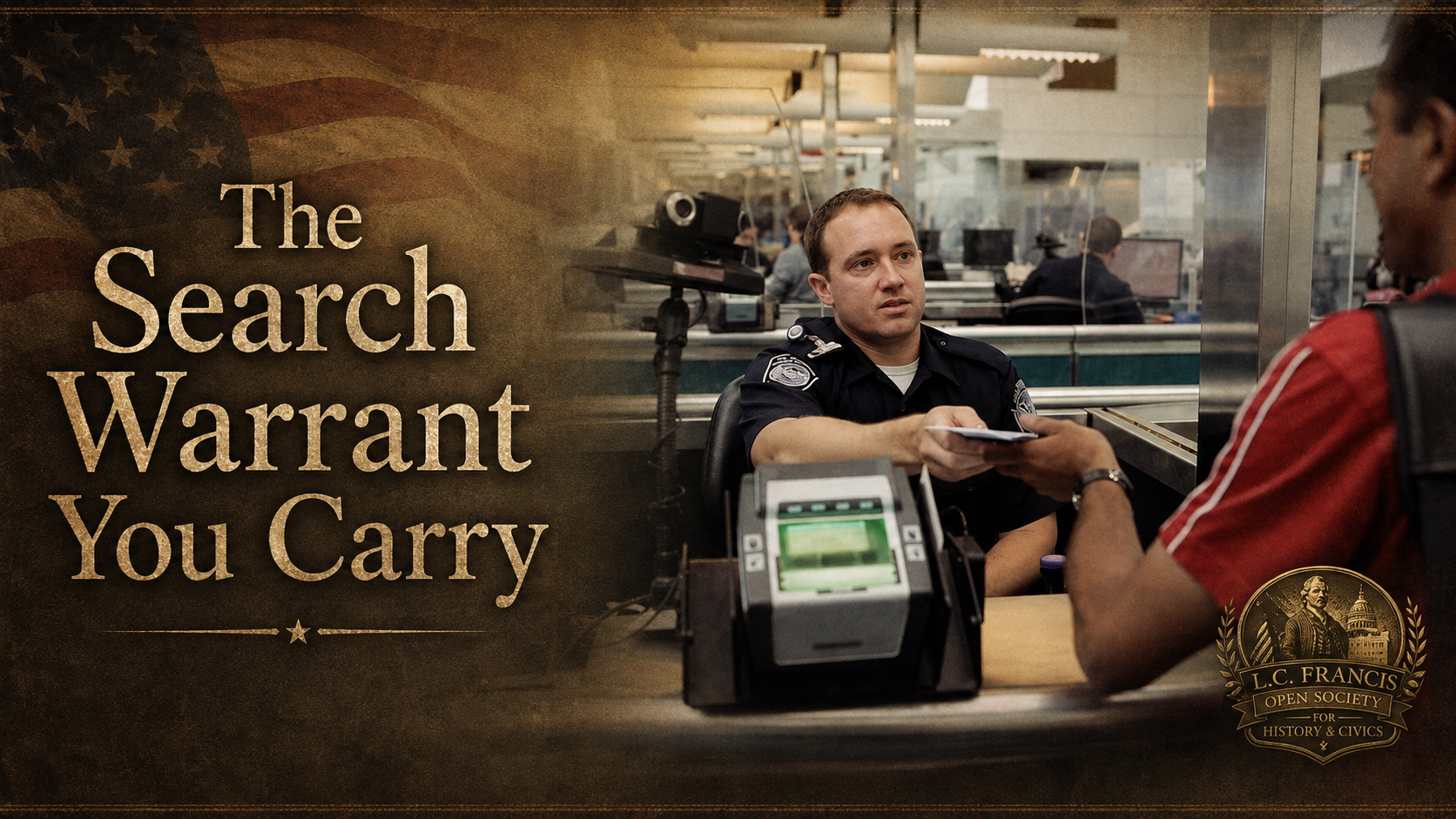
“I will to my dying day oppose, with all the powers and faculties God has given me, all such instruments of slavery.” Dear Friends, Every American who has spent time abroad likely recalls a particular special moment. The aircraft touches down softly, and the cabin buzzes with the cheerful sound of seat belts clicking and phones reconnecting. Passengers quickly grab their coats, passports, and small keepsakes they brought from across the ocean. Then, they take a relaxed walk under the bright fluorescent lights toward the inspection booths. An officer looks at the photograph, glances at the face, and then returns the passport with two words that offer comforting reassurance, settling something deep inside. “Welcome home.” For nearly thirty years, I had the privilege of crossing borders, serving in uniform, and fulfilling my official duties. I recall standing in lines, holding orders, identification cards, and sealed documents, feeling the quiet exhaustion from a life spent between nations. Each time I returned, those two words carried deeper significance… more than mere arrival. They symbolized my re-entry under the protection of our Constitution I had sworn to defend. I used to believe that returning to a country meant you couldn’t investigate an American citizen’s private life without a valid reason, since I thought the government needed to have one beforehand. Today, an officer can kindly follow up with a friendly remark after saying “Welcome home.” “Unlock your phone.” The device beside your Sunday coffee isn’t merely like a filing cabinet, family album, medical record, bank vault, diary, or a map of all your travels. It’s special because it contains all of those along with additional tidbits about your life. Your phone basically acts as a detailed recorder of your life, tracking when you wake up and where you sleep. It stores cherished photos of your grandchildren, meaningful messages from your spouse, medical prescriptions, crucial conversations with your lawyer, donations to causes you support, searches during anxious moments, and private confessions from friends who trusted you with parts of their lives they never imagined sharing with the government. Under British occupation, a colonial customs officer once needed to enter a house to gather information about someone. Now, that same house can be accessible directly from your pocket. Back on July 10th, journalist Max Blumenthal arrived at Washington’s Dulles International Airport following his reporting trip in Iran. Customs and Border Protection officers directed him to secondary inspection, where he was detained for approximately two and a half hours. In this period, they inquired about his work, financial situation, and the individuals backing his journalism. Then they asked him to unlock two phones. Blumenthal politely refused to share the passcodes, and the officers took the devices. About a week later, the government returned them after his attorneys requested emergency relief in federal court. However, officials said they had not been able to access the phones. Federal Judge Leonie Brinkema wasn’t convinced by that explanation and asked the government to provide details about who had possession of the devices, when, and what actions were taken while they were in federal custody. You don’t need to admire Max Blumenthal, trust his reporting, agree with his politics, or defend every word he’s written. That’s exactly the point. Governments rarely test dangerous powers first on people the public admires. They start with controversial, unpopular, or overlooked individuals, and easily forgotten, counting on our silence to turn an abuse into precedent. By the time this power reaches someone we care about, the government no longer needs to seize the principle from us. We already gave it away when defending it required courage. Just three days after the phones were confiscated, the United States Court of Appeals for the Fourth Circuit issued a ruling with broad implications. The court determined that border officers can manually search a traveler’s cellphone without a warrant or particular suspicion, marking a notable development. There is no assertion that you have committed a crime, no evidence that your phone contains illegal materials, and no judge examining the government’s justification. At the border, according to that ruling, an officer may examine the visible contents of your digital devices simply because you are crossing from abroad into the country. In fiscal year 2025, Customs and Border Protection searched 55,318 electronic devices, the highest annual total they’ve reported. Of these, over 13,000 involved American citizens. The agency claims these searches are rare and, statistics show, they generally are. Yet, the more significant issue isn’t the frequency of searches on citizens but the extent of government authority over each person who might be next. America historically fought a revolution centered on this principle, highlighting its deep resonance with the people. For instance, in February 1761, twenty-five-year-old John Adams entered the lively council chamber at Boston’s Old State House, full of eagerness and perhaps some nerves. Nearby, five judges in vibrant scarlet robes and tall wigs sat by the fire, forming a vivid scene. Before them stood James Otis, a keen and passionate Boston lawyer who had opted to resign his official position instead of defending the disputed writs of assistance. These writs were more than typical search warrants. They did not specify a particular house, name a suspect, or describe the items officers sought. Instead, they granted customs agents wide authority to search any location and look for anything they believed might be concealed. Otis called the writ “the worst instrument of arbitrary power” ever listed in an English law book. He warned that anyone with such authority could become “a tyrant in a legal manner.” Nearly sixty years later, Adams recalled that Otis’s argument represented “the first scene of the first act” of resistance against Britain’s unfair claims. At that time, Adams felt that “the child Independence was born.” The Fourth Amendment was a crucial part of that child’s inheritance. It wasn’t merely about preventing government probes but ensuring the government provided clear explanations for its actions. It required detailed descriptions, evidence, and a judge-issued warrant before any officer could enter a person’s private space. In 2014, the Supreme Court highlighted that a cellphone is far more than a small device; Chief Justice John Roberts described it as holding “the privacies of life,” underlining its personal importance. The Court clearly instructed police to “Get a warrant” before searching a phone after an arrest, safeguarding individual privacy. That constitutional clarity becomes somewhat less clear when you’re standing at the airport Passport Control line. The government emphasizes that borders have historically permitted search exceptions, as countries must verify what is entering. This is understandable when officers inspect luggage for drugs, weapons, undeclared money, or prohibited items. Ultimately, a suitcase contains what a traveler has packed for their journey. At first, facial recognition software, which is available on most phones, may feel convenient, but at the border it can make your phone easier to open, not safer. A customs official can ask you to look into the screen or place your finger on the device, and the courts remain divided over when the government may compel such biometric access. A passcode generally offers a stronger constitutional argument because it requires you to reveal something stored in your mind. Citizens concerned about a search can disable Face ID or turn off the phone before reaching the inspection, which forces the device to require the passcode. Nonetheless, your phone carries something far more revealing than luggage: You. Searching not only uncovers the events at the border that afternoon but also reveals a deep history of movements, relationships, ideas, vulnerabilities, conflicts, and loyalties. It can identify everyone who trusted a journalist, sought legal advice, contacted an organizer, looked for medical assistance, questioned their faith, opposed a president, or simply admitted to feeling scared. This process allows us to understand the numerous stories behind each name and action, emphasizing the complexity and richness of personal experiences. The old writ of assistance authorized officers to search all rooms within a house. This new law gives the government the authority to search every room inside someone’s life, indicating a further step towards the tyranny the Sons of Liberty fought against. That phone beside your nightstand may appear innocuous, as tyranny often conceals itself behind objects that seem familiar and comforting to hold. However, a more pressing question today is whether an American returning home must relinquish their detailed personal record stored on their device in exchange for their passport and permission to re-enter. This prompts a deeper reflection on how we balance security and personal freedom. I spent much of my adult life serving this country by regularly crossing international borders. I always took pride in knowing that I somehow helped defend Americans’ rights, ensuring their constitutional protections were upheld even during customs inspections… It’s a reminder that every one of us, whether we wear a uniform or are an ordinary citizen, must play a vital role in defending our freedoms. Saying “Welcome home” should mean that the government’s primary duty is to safeguard your freedom and well-being. It should never become the greeting offered right before the government demands the password to your life. Vivat Constitution! If you believe Americans make better citizens when they understand American history, constitutional government, and today’s political challenges, would you consider becoming one of ten new paid subscribers this month? Our paid members allow the Open Society to continue researching, writing, and publishing independent historical and constitutional analysis without chasing sponsors, advertisers, or clickbait. Moreover, you can help maintain this Substack site as a civic resource for students, community organizers, seniors, and anyone seeking clarity in public life. |
L.C. Francis Open Society for History & Civics
Author and historian connecting America’s past to the forces shaping our Republic today. Evidence-driven essays on history, civics, democracy, and public life for readers who believe understanding the past is essential to protecting the future.
“A fondness for power is implanted in most men, and it is natural to abuse it when acquired.”— Alexander Hamilton, The Farmer Refuted, 1775 Dear Friends, I rarely republish an essay, but last night I revisited something I wrote on December 21, 2025, when Donald J. Trump first tried to graft his name onto the John F. Kennedy Center for the Performing Arts. I called it “Names Matter: Trump’s Hostile Takeover.” At the time, I argued that this was about far more than letters on a building. It was...
This is a test of the new Open Society sending address.
“The aim of every political constitution is, or ought to be, first to obtain for rulers men who possess most wisdom to discern, and most virtue to pursue, the common good of the society.”— James Madison, Federalist No. 57 Dear Friends, Over the years, I’ve learned to enjoy not just reading about the Sons of Liberty and the 18th-century Founders; I often explore the lives of more recent presidents as well. I’m mainly interested not only in their major achievements upon reaching the White House...