Author and historian connecting America’s past to the forces shaping our Republic today. Evidence-driven essays on history, civics, democracy, and public life for readers who believe understanding the past is essential to protecting the future.
The Forgotten Amendment That Suddenly Matters Again
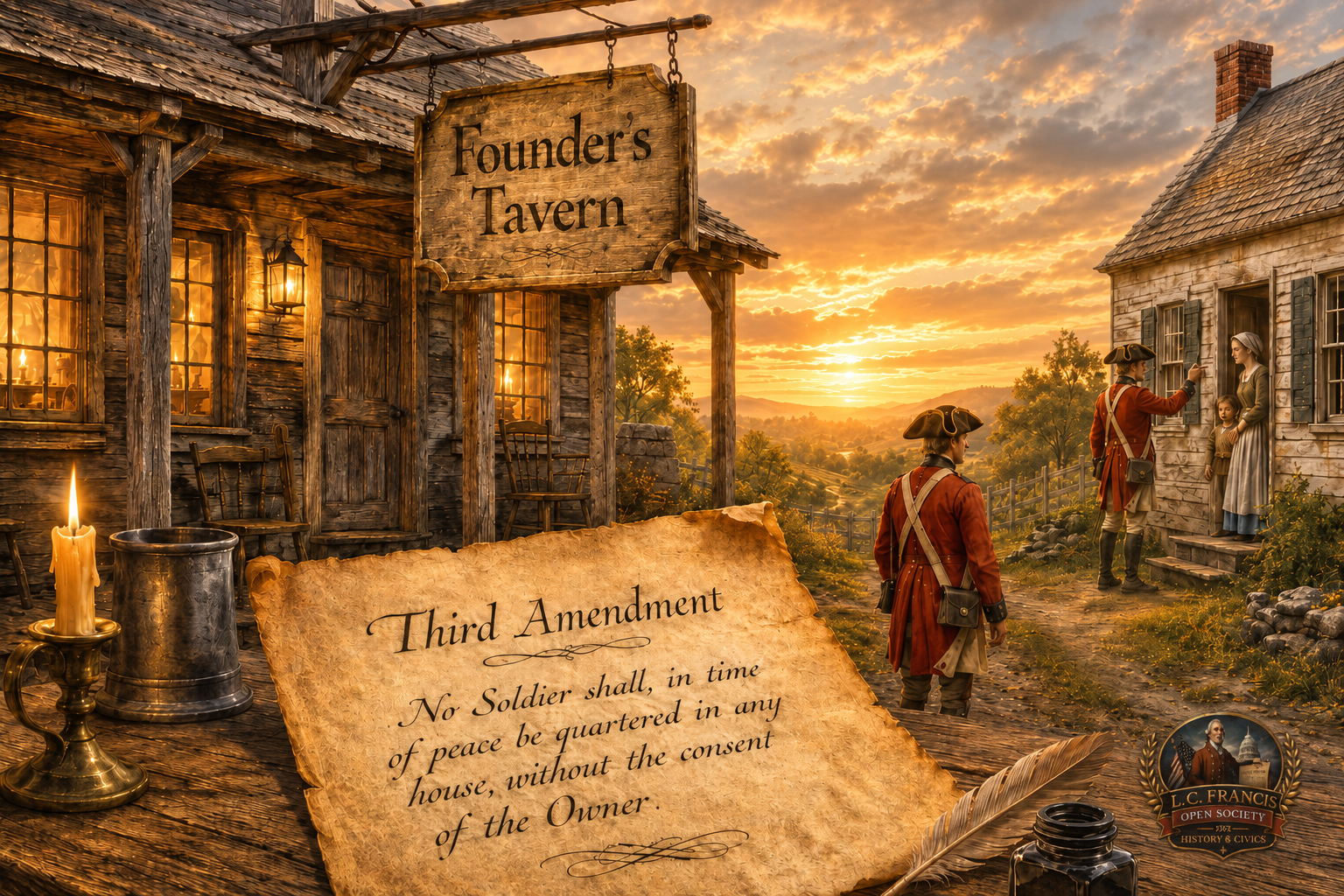
“Those who are taxed without their own consent, given by themselves, or their representatives, are slaves.” Dear Friends, Most Americans are familiar with the amendments we often discuss. The First Amendment safeguards speech, religion, the press, assembly, and the right to petition. The Second Amendment continues to spark ongoing debate about guns. The Fourth Amendment remains important whenever police, courts, phones, privacy issues, or warrants are involved. But the Third Amendment usually sits alone in the corner. No soldier shall be quartered in any house in time of peace without the owner's consent. At first, it seems almost charming. We imagine redcoats, candlelit rooms, wooden floors, and a colonial family being told that a British soldier would now sleep under their roof. It appears like a problem from a different country and a different era. But stay with that family for a moment. Picture a knock at your door. Consider being told that your home, firewood, food, privacy, and peace are now to serve the interests of power. The soldier might be courteous, the officer might present official documents, and the command letterhead may appear formal. Yet, the harm remains straightforward: something that is yours is being taken or used without your permission. This is the true story behind the Third Amendment. The Third Amendment was never merely about soldiers in a home; the Founders wrote it to draw a clear line between the authority of government and the ordinary life of citizens, insisting that consent must precede intrusion or power becomes occupation. That boundary is once again in the news; this time, it appears not as a red coat, but as a data center. For years, Americans have been told to think of the digital world as “the cloud,” implying that our searches, emails, photos, banking info, medical records, government data, and AI tools exist somewhere above us in the sky. However, the cloud isn’t in the sky; it’s housed in data centers…buildings that require land, water, electricity, cooling systems, transmission lines, tax agreements, zoning permissions, and public trust. According to a recent report by the Department of Energy’s Lawrence Berkeley National Laboratory, U.S. data centers consumed about 58 terawatt-hours of electricity in 2014. By 2023, consumption had risen to 176 terawatt-hours. Federal researchers project that by 2028, data center electricity use could range from 325 to 580 terawatt-hours, representing approximately 6.7 to 12 percent of total electricity use in the United States. That is not a minor technical point; it is a public responsibility. Virginia already shows what it looks like when the future arrives early. Dominion’s service area is experiencing rapid growth, mainly driven by data centers and large energy consumers. State regulators estimate that electricity demand will grow by 5.5 percent each year over the next decade and will double by 2039. This is the point where the story shifts from focusing on technology to emphasizing self-governance. If a data center requires significant electricity, who bears the cost of expanding the grid? If it needs water for cooling, who communicates that to the public prior to signing the agreement? When local land is rezoned, tax incentives are provided, or secrecy agreements are implemented, at what point do residents gain a genuine voice? This is the Third Amendment question presented in contemporary terms. The Founders were unfamiliar with server farms, AI, cooling towers, utility filings, or cloud storage. However, they understood power. They recognized that power usually enters everyday life for a logical reason…whether it’s the army requiring shelter, the empire needing order, or the future demanding infrastructure. The citizen is told to make room. This is why the Third Amendment is important again. It reminds us that consent isn’t merely a formality or something tacked on after experts, corporations, agencies, and politicians finalize their deals. Consent is what distinguishes a Republic from controlled obedience; without it, we are not treated as citizens but are slowly reshaped into Subjects of the companies and officials who control the data centers, the power lines, and the terms of access to our own communities. This does not oppose technology itself. Instead, it calls for honesty regarding its effects, seeking consent prior to development, and accountability before ordinary citizens are asked to shoulder the costs. Across our country, communities are already demonstrating how this approach can be implemented. This is not an argument against technology. It is a demand for honesty about its impact, consent before development, and accountability before ordinary citizens are asked to bear the costs. Around the country, communities are already showing us what that looks like when people refuse to be rushed, confused, or ignored. In Oklahoma, the Seminole Nation voted unanimously to pause generative AI and large-scale data-center projects on its territory because water, land, and sovereignty are not bargaining chips. Along the Columbia Gorge, the Yakama Nation has opposed a massive energy project linked to a proposed data center near sacred ground, reminding the rest of us that land carries memory and cannot be treated as vacant space simply because a developer finds it useful. Even in my home state of Georgia, Fayette County residents forced a more rigorous public conversation after learning that a data-center project had consumed millions of gallons of water before the public fully understood what was happening. These communities teach a clear and powerful lesson: instead of fearing the future, we should ensure it responds to those who will live with it. Before permits are approved, tax breaks are given, power lines are laid, or water is extracted, citizens deserve straightforward answers about what will be used, what will be promised, who will benefit, who will cover the costs, and what occurs if promises are not kept. This is not obstruction; it is self-governance functioning properly. These examples illustrate a model worth following. Communities can insist on plain-language disclosures of electricity and water use, required infrastructure, and financial responsibility before permits are approved. They can protect sacred lands, watersheds, and local resources, ensuring that technological growth proceeds with public awareness and consent. Building the future does not mean bypassing the people who will live with it. True self-government, as these communities demonstrate, begins when citizens are given the information, the voice, and the authority to say yes—or no. The old quartering forced a soldier into a home and told the citizen to make room for power. The new quartering is quieter, but the principle remains the same. When vast systems demand a community’s electricity, water, land, silence, and trust before We the People have been fully informed, the issue is no longer solely a matter of technology. It is consent. That is why the Third Amendment still speaks to us. It’s a solemn reminder that freedom is not only the right to be left alone once power arrives. Freedom is the right to be asked before power moves in. Our Republic does not begin with permission from the powerful; it begins with the consent of the people. Vivat Constitution! If this article resonated with you, or offered even a small measure of clarity in a difficult moment, please share it with friends and loved ones who still care deeply about our Republic. Please also consider becoming a free or paid member of the Open Society; you may cancel at any time, and every paid subscription helps keep this work independent, open, and available to everyone. To our paid members, thank you for keeping the door open, the lights on, and this work free for all who need it. |
L.C. Francis Open Society for History & Civics
Author and historian connecting America’s past to the forces shaping our Republic today. Evidence-driven essays on history, civics, democracy, and public life for readers who believe understanding the past is essential to protecting the future.
“A fondness for power is implanted in most men, and it is natural to abuse it when acquired.”— Alexander Hamilton, The Farmer Refuted, 1775 Dear Friends, I rarely republish an essay, but last night I revisited something I wrote on December 21, 2025, when Donald J. Trump first tried to graft his name onto the John F. Kennedy Center for the Performing Arts. I called it “Names Matter: Trump’s Hostile Takeover.” At the time, I argued that this was about far more than letters on a building. It was...
This is a test of the new Open Society sending address.
“The aim of every political constitution is, or ought to be, first to obtain for rulers men who possess most wisdom to discern, and most virtue to pursue, the common good of the society.”— James Madison, Federalist No. 57 Dear Friends, Over the years, I’ve learned to enjoy not just reading about the Sons of Liberty and the 18th-century Founders; I often explore the lives of more recent presidents as well. I’m mainly interested not only in their major achievements upon reaching the White House...