Author and historian connecting America’s past to the forces shaping our Republic today. Evidence-driven essays on history, civics, democracy, and public life for readers who believe understanding the past is essential to protecting the future.
Aristocracy Without Crowns
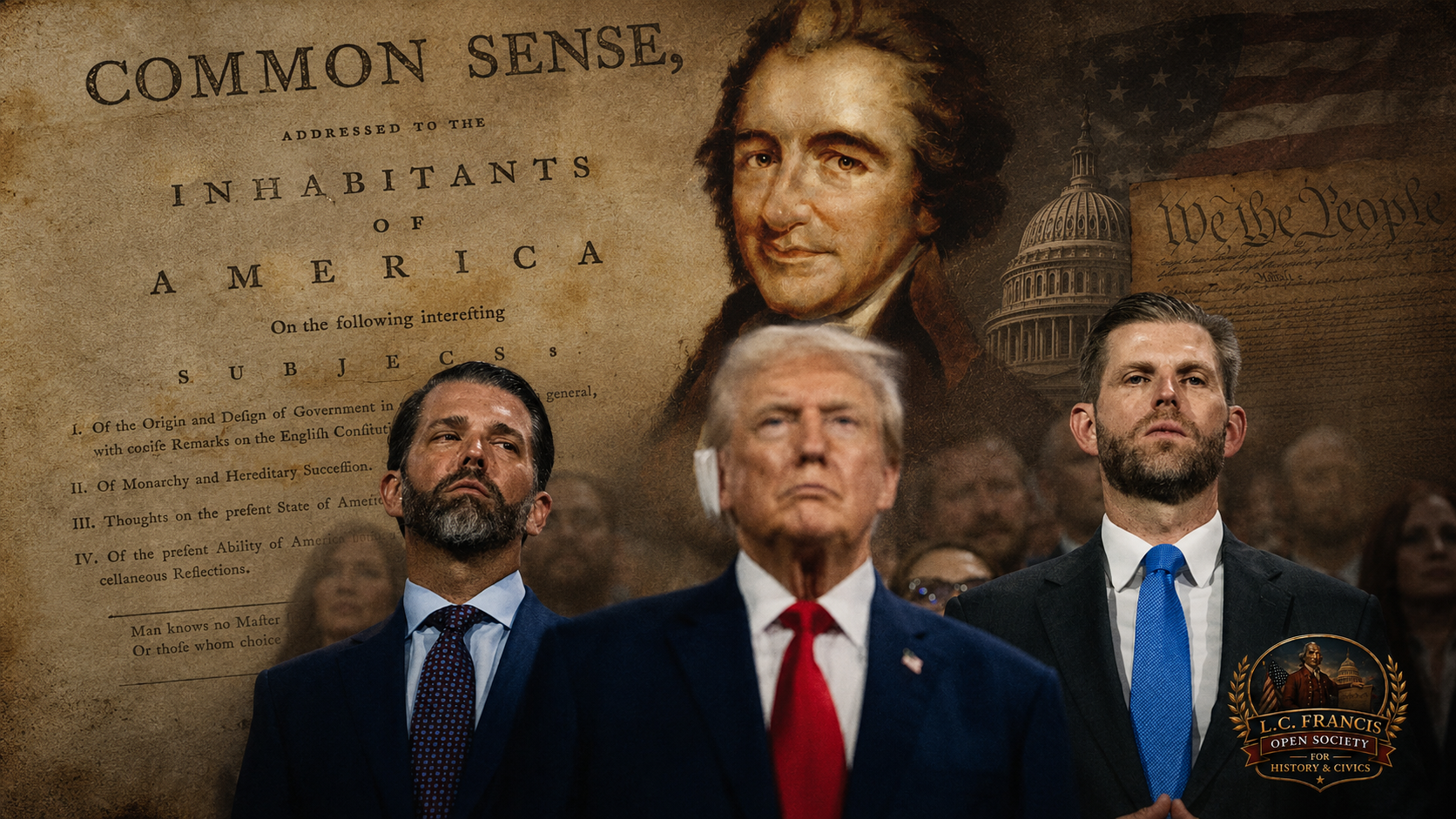
“Those who hold, and those who are without property, have ever formed distinct interests in society.” Dear Friends, Let’s imagine ourselves traveling to Philadelphia together in January 1776, exploring the rich history of the City of Brotherly Love and thrilling moments of our Revolution. The American revolt against British occupation was already underway, with skirmishes at Lexington and Concord and at Bunker Hill, involving both Colonial militias and British forces. However, the concept of independence remained uncertain for many. Most colonists preferred a peaceful resolution with the Crown. Furthermore, the Continental Congress had not officially declared that the thirteen colonies intended to form a new nation. Now, before we go any further with our story today, I know some of you may remember Thomas Paine from a history class as the fiery pamphleteer whose Common Sense helped push the colonies toward independence. What most of us were never taught is that Paine carried his revolution much further, into a fight over wealth, inheritance, poverty, and what economic independence actually means in a free Republic. It’s important to remember, contextually, that Thomas Paine was a 38-year-old immigrant from England who not only authored a controversial pamphlet but also arrived in America just over a year earlier, carrying only a Letter of Introduction from Dr. Benjamin Franklin. Although Paine wasn’t deeply connected to the colonial aristocracy (he wasn’t a Virginia planter, a Boston merchant, or a prominent lawyer), he was eager to make an impact with his revolutionary contemporaries. Nonetheless, Paine’s diction and prose were simple, and he wrote in a way that directly connected with farmers, shopkeepers, blacksmiths, and dockworkers… people who might not have the time or interest in complicated political debates about Parliament and the colonies. Paine simplified the idea of monarchy by stripping away its formalities and always asked clear, simple questions everyone could understand: why should one family have the power to govern millions of other families? The impact was significant. According to the Library of Congress, over half a million copies of Common Sense were published in twenty-five editions within its first year, indicating an impressive reach in colonial America. Paine effectively transformed a once-quiet political debate into lively discussions in taverns, workshops, and homes. Five months after its publication, the Continental Congress convened to appoint a special committee to draft the Declaration of Independence. That’s the Thomas Paine most Americans remember, if they remember him at all. He was the fiery pamphleteer who motivated Americans to muster the courage to oppose a king, setting the stage for Thomas Jefferson’s Declaration of Independence. But our story extends beyond Philadelphia in 1776. About twenty years later, Thomas Paine was in Paris, now an influential and increasingly powerful international political figure. He had naturally supported the French Revolution and was elected to the French National Convention. However, during the Reign of Terror, the revolution turned against him. As a matter of fact, on December 28, 1793, he was arrested and held in Luxembourg Prison for most of the following year. Paine later described the prison as a place where men were regularly taken to the guillotine, and he believed his name might have been on one of those execution lists. Nonetheless, he recuperated and took solace in James Monroe’s residence in Paris, who was at the time the American minister to France and would subsequently serve as our president. Around this time, Paine encountered an inspiring sermon by Richard Watson, Bishop of Llandaff, titled “The Wisdom and Goodness of God, in having made both Rich and Poor,” which clearly conveyed its heartfelt message. The bishop was defending an ancient assumption. Great gaps in wealth were simply part of the natural order; there would always be rich and poor people, and Providence presumably had reasons for arranging humanity that way. One can go so far as to say that Paine devoted his life to questioning those who defend human hierarchy by asserting that it is natural… His response was devastatingly simple: “It is wrong to say God made Rich and Poor.” Human beings had created those distinctions. Now Paine started exploring that idea, a path very few colonists were willing to pursue. When he challenged monarchy in 1776, Paine’s primary issue wasn’t merely that George III was a weak or corrupt king. His main concern was the concept of hereditary power: the idea that no child is born with an inherent right to govern solely by virtue of being born into a royal family. By the end of the 1700s, Paine looked at economic life across our new Republic and noticed another accident of birth. In essence, one child could enter the world heir to land, houses, money, and the accumulated labor of generations. Another could arrive in the same town with nothing beyond whatever strength, intelligence, and good fortune life happened to provide. Paine didn’t believe that private property was inherently evil, nor did he consider himself a socialist long before Marx and Engels introduced those terms. This point matters enormously because modern politics has a bad habit of kidnapping historical figures and forcing them to wear contemporary ideological clothing. 25% Off Until Midterms to Upgrade Paine championed the importance of private property, believing that cultivation, industry, and commerce have significantly enhanced human life. He regarded land clearing, planting, building, and wealth creation through hard work and entrepreneurship as deserving acknowledgment. Moreover, Paine held that the value generated from these activities rightfully belonged to the person responsible, underscoring his support for personal ownership and accomplishment. His argument concerned something no owner had thought of: the earth itself. Before building walls or fencing off a field, or drafting a deed, Paine fundamentally believed that the natural world was shared by all humans. While private property increased productivity, it also created a new human situation: for the first time, someone could be born without any real claim to the land needed to survive. Paine believed civilization owed that person compensation. In 1797, he published his answer under the wonderfully provocative title Agrarian Justice. His idea might still make Washington’s politicians uneasy even today. Under Paine’s plan, about 10% of inherited property would be allocated to a national fund. From this fund, all individuals turning twenty-one, regardless of wealth or gender, would receive £15. Paine envisioned this sum as sufficient to buy a cow and basic tools, establish a household, or provide a small financial boost to help someone start out in adulthood. Then, beginning at age fifty, citizens would also be entitled to £10 annually for life. Paine was talking about an idea akin to a universal inheritance and old-age pension long before Social Security, the modern income tax, industrial capitalism, or the current political language used to resolve debates. His reasoning is more compelling than the numbers alone. Paine insisted that he was pleading for “a right, and not a charity.” He argued that charity usually waits until someone needs help, offering compassion. Paine, however, questioned why a civilized society creates a system that often leads to despair, only to later commend those who assist. This was a thought-provoking 18th-century idea about how society reacts to hardship. Paine even expected that many contemporaries would accuse his proposal of attacking wealth. Paine poignantly called himself “a friend to riches.” He did not object to people becoming affluent. What disturbed him, however, was seeing affluence and misery become hereditary neighbors, particularly when the legal system that protected one citizen’s fortune was maintained by the society in which everyone else lived. Now, I’d like you to fast-forward to 2026 and look at our nation. The Federal Reserve reported this year that 47% of Americans between 18 and 29 needed financial help from someone outside their household in 2025. Nearly one in four received help with rent, a mortgage, utilities or other housing expenses. Only 45 percent of that age group said they could cover a $400 emergency using cash or its equivalent. Affordable housing remains a significant issue. Recently, Harvard’s Joint Center for Housing Studies reported that, under current assumptions, a household needs an income of more than $120,000 to afford the median-priced home in America; in 2020, the threshold was about half the price at around $66,000. Furthermore, two-thirds of renters earning less than $30,000 spend more than half of their income on housing. This is where Thomas Paine becomes an uncomfortable link to modern life. It’s crucial for us not to base current policies on 18th-century economics, though not entirely out of the question. Paine wouldn’t have predicted modern innovations such as mortgage-backed securities, multinational corporations, 401(k)s, student loans, or billionaires whose wealth exceeds that of small countries. What he understood, however, was dependence. Someone with a few thousand dollars saved can leave a bad job, fix a broken transmission, move for better opportunities, pay an apartment deposit, cover medical deductibles, start a small business, or survive several weeks without a paycheck. However, those living constantly on the edge, paycheck to paycheck, cannot make all these decisions, even if their legal rights seem equal on paper. That distinction is important in our Republic because independence was not merely a word the Sons of Liberty threw around to describe our struggle with the Crown. Instead, it defined the kind of citizen and the kind of Republican government that were necessary. Paine was concerned about a society in which poverty persisted across generations, having previously spent his life opposing a system that entrenched power. That is the part of his American story that we somehow stopped teaching. We recall the Thomas Paine who told colonists that a farmer didn’t need a king to rule him. However, we seldom mention the older Paine, who questioned whether that farmer could truly remain independent without owning enough property to control his own life. That question belongs in our present argument about affordability far more comfortably than the labels we keep hurling at one another. We often have heated discussions about tax rates, inheritance taxes, housing policies, labor laws, wages, and the proper scope of government. I’m certain Paine would have enjoyed taking part in these discussions, as he was especially naturally adept at contributing to such lively debates. However, before choosing a policy, he likely wants us to address the more challenging question first… Think about how much economic independence an average individual requires… at what stage does political independence become truly meaningful beyond mere words on paper? If Thomas Paine traveled to America in 2026, he likely wouldn’t be impressed by debates over whether helping working families is too liberal or “communist or socialist” or if taxing inherited wealth is too radical. He would quickly recognize the core issue: millions of Americans work full-time, and sometimes two or three jobs, yet still struggle to afford essentials like groceries and rent, delay buying homes and having children, and fear that a simple broken transmission could cause financial destitution. Meanwhile, the president reported over $1.4 billion in income from his family’s cryptocurrency ventures in 2025, companies that expanded even as his administration adjusted federal cryptocurrency regulations. Paine dedicated his life to opposing the idea that birth, status, or proximity to power grants people access to opportunities others cannot reach. He would likely be unimpressed by a Republic in which political office coexists with immense private wealth, while ordinary people are told that high housing costs, expensive food, high fuel costs, and economic insecurity are simply the market’s burden. Right now, American families are paying roughly 33% more for food than in 2019. Paine would argue that liberty means little when ordinary citizens are legally free yet economically trapped, while inherited wealth and political influence allow a privileged few to live beyond the pressures that govern everyone else. To him, that was not Republican equality but aristocracy wearing American clothes. He would remind us of his original purpose in writing Common Sense. Our Republic is meant to challenge the old compact in which power safeguards privilege while ordinary citizens bear the costs. If Washington becomes a place where public authority boosts private wealth while hardworking families struggle to afford basic necessities, then Paine’s argument is no longer confined to an eighteenth-century pamphlet. Paine’s warning stands at our doorstep, demanding to know how a nation that once overthrew hereditary privilege became comfortable with Donald J. Trump and his family turning political power into private financial windfalls while leaving ordinary citizens to fight over the rising cost of groceries, rent, and a decent life. Vivat Constitution! If you believe Americans make better citizens when they understand American history, constitutional government, and today’s political challenges, would you consider becoming one of ten new paid subscribers this month? Our paid members allow the Open Society to continue researching, writing, and publishing independent historical and constitutional analysis without chasing sponsors, advertisers, or clickbait. Moreover, you can help maintain this Substack site as a civic resource for students, community organizers, seniors, and anyone seeking clarity in public life. |
L.C. Francis Open Society for History & Civics
Author and historian connecting America’s past to the forces shaping our Republic today. Evidence-driven essays on history, civics, democracy, and public life for readers who believe understanding the past is essential to protecting the future.
“A fondness for power is implanted in most men, and it is natural to abuse it when acquired.”— Alexander Hamilton, The Farmer Refuted, 1775 Dear Friends, I rarely republish an essay, but last night I revisited something I wrote on December 21, 2025, when Donald J. Trump first tried to graft his name onto the John F. Kennedy Center for the Performing Arts. I called it “Names Matter: Trump’s Hostile Takeover.” At the time, I argued that this was about far more than letters on a building. It was...
This is a test of the new Open Society sending address.
“The aim of every political constitution is, or ought to be, first to obtain for rulers men who possess most wisdom to discern, and most virtue to pursue, the common good of the society.”— James Madison, Federalist No. 57 Dear Friends, Over the years, I’ve learned to enjoy not just reading about the Sons of Liberty and the 18th-century Founders; I often explore the lives of more recent presidents as well. I’m mainly interested not only in their major achievements upon reaching the White House...